Finding people to do things with, wherever you are
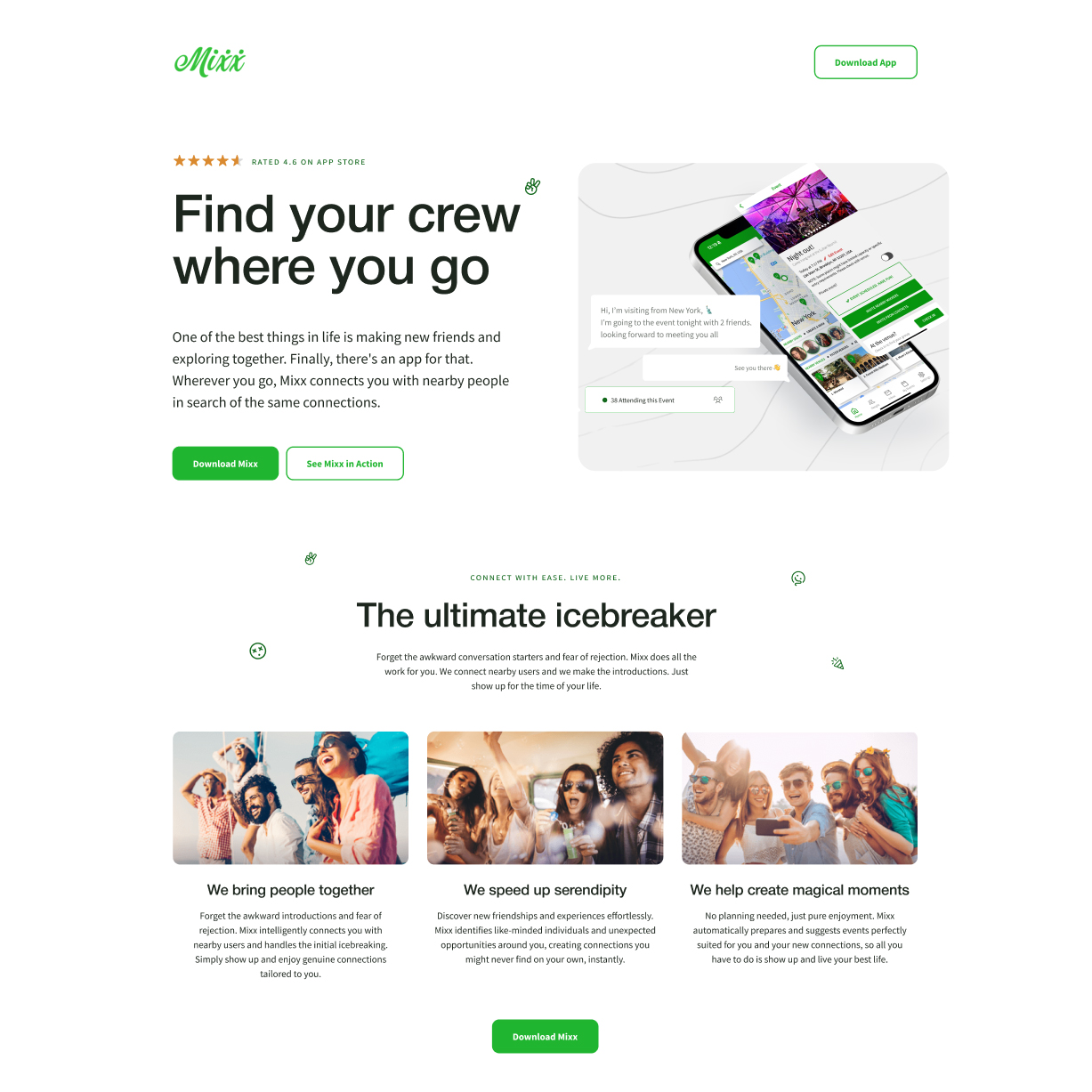
A visitor arriving in a new city might know what they want to do but not who to do it with. Mixx Together was built around that situation: helping locals and travelers discover nearby activities and meet people with similar interests. Its users could set preferences, find gatherings and venues, and stay in touch with others after an event.
Making that idea work on a phone involves several moving parts. Location data has to be current, event feeds need to respond quickly and invitations and messages must reach the right people. When the founder approached SLIDEFACTORY in March 2023, the existing React Native app was still struggling with registration errors, incomplete event loading, mismatches with its Figma designs and growing Google Cloud charges.
We joined as the mobile development and project management team, starting with code review, a prioritized backlog and working test builds. The engagement continued for almost two years as we prepared both iOS and Android releases and extended the social, messaging and venue features.
Making the app match the design and stay fast
We began with the parts of the experience that new users encountered first: registration, permissions for cameras and photos, venue filters and screens that no longer matched the Figma files. Reviews compared the design and the running app screen by screen, with working TestFlight builds at sprint milestones.
Performance required deeper investigation. MobX state listeners weren’t reliably updating the screens that depended on them, while sequential requests and repeated network calls slowed event loading. We built a small test of the state flow, corrected the listeners, parallelized independent requests and removed unnecessary calls. In our testing, changing preferences fell from about eight seconds to near-instant feedback. We also corrected incomplete event loads when users opened the app or changed location.
The same debugging approach applied to real-time behavior. Messages began appearing as they arrived, unread states were corrected and duplicate invitations were traced to overlapping database watchers at two levels of the data structure.
Getting location costs under control
Finding nearby venues required Google’s Places API, and by spring 2023 its charges were rising faster than the client expected from the user base. We investigated with Google support and found overly broad API key permissions and repeated development requests. We restricted the keys, created a development cache using two fixed locations and grouped venue lookups for users in the same area to avoid repeating the same request.
We also investigated alternative place-data providers rather than assuming the existing service was the only option. In August 2023 we delivered a comparison of provider pricing against projected usage, allowing the founder to evaluate the trade-offs.
Shipping to both stores
Most early testing had been on iPhone, so Android needed its own release work. We established Android builds, corrected platform-specific layouts, fonts, shadows, map markers and keyboard interactions, and set up signed builds and Google Play testing. Dynamic links allowed shared events to open in the installed app or send someone to the appropriate store.
The app reached the App Store and Google Play in summer 2023. Around that release, we also delivered event editing, multiple categories per event, photo comments, private events, user blocking and search for people. When checked in October 2026, the Google Play listing showed more than 5,000 Android downloads.
Inviting friends who aren’t on the app yet
After the initial release, the founder focused on helping users invite people outside the existing community. In 2024 we built contact selection, friend groups and SMS invitations, including the ability to invite someone who hadn’t yet registered. Those invitations required temporary account records that could later be merged with real accounts without losing event invitations or creating duplicate people.
We implemented the backend with Firebase Cloud Functions and Twilio, taking care of phone-number normalization, country codes and cases where a user initially declined access to contacts and later enabled it. We also worked through toll-free number verification and consent handling, with opt-in and opt-out rules, an allow list and a block list. Sending and message composition moved to the server rather than remaining in the mobile app.
Expanding the community after launch
Once the invitations and messaging paths were established, the product expanded to include sponsored venues, initially in New York in spring 2024. We built a bulk importer for client-provided venue lists, checked for closures and incorrect categories and improved the stored address data.
Support continued beyond feature releases. In September 2024 we added full account deletion, including a user’s events, messages and photos, and Sign in with Apple with account merging for previously invited users. We also handled operating-system and Xcode changes, accessibility and text-sizing fixes, and updated screenshots for iPhone and iPad store listings into early 2025.
A social app that made it to both stores
Mixx Together moved from an inconsistent mobile build to releases on both iOS and Android, with the founder continuing to expand its social features afterward. Along the way, we addressed the practical issues that could interrupt the experience: slow preference changes, incomplete venue data, duplicated invitations, costly location requests and the complications of inviting people who hadn’t joined yet.
Across roughly 1,200 hours from March 2023 to February 2025, the work followed the product beyond launch into messaging, sponsored venues, account management and ongoing compatibility updates. Preference changes that had taken about eight seconds responded almost immediately after the state-management fixes. More importantly for the product itself, people could now find nearby events, invite friends outside the app and keep those connections going through messaging on both mobile platforms.