Book

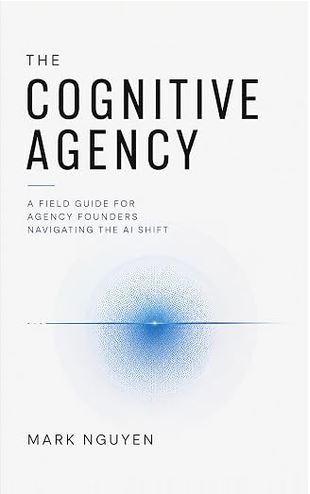
The Cognitive Agency

The Cognitive Agency is a field guide for agency founders and leaders who want to rethink the economics, workflows, and operating model of their business around what AI has already changed.

A Field Guide for Agency Founders Navigating the AI Shift

Your agency is doing more work in less time. Turnaround is faster. Clients are happier. The team is producing better work with fewer revisions.

And revenue is going down.

That’s the problem The Cognitive Agency is about.

AI is making agencies dramatically more capable, but most are still built around a business model that assumes better work requires more human hours. When twenty hours of production becomes four, the old math starts working against you. Efficiency goes up. Capacity goes up. The work gets better. But if you’re still selling time, the financial upside doesn’t necessarily follow.

The Cognitive Agency is a field guide for agency founders and leaders who want to rethink the economics, workflows, and operating model of their business around what AI has already changed.

Get the Book

About the Book

What you'll discover

Why efficiency started costing you

Production time collapsed and the billing model didn’t move with it. What clients are actually paying for once a week of work becomes a day.

Pricing after the billable hour

Retainers, fixed fee, subscriptions and outcome pricing, with the cash-flow timing problem that catches agencies moving several accounts at once.

Specification as leadership

Writing a brief an agent can execute forces decisions out of your head earlier. The work becomes transferable instead of dependent on one person.

Delegation without abdication

How much review a new workflow needs, and how to calibrate it down as you learn where it actually fails rather than where you fear it might.

Quality at speed

Review systems built for the faster cycle. The difference between velocity and throughput, and why first-draft time flatters the numbers.

Hiring, and stepping back

Hiring for judgment when execution gets cheap, and building an agency that keeps working with the founder further from the centre of it.

Mark Nguyen

Mark Nguyen

Mark Nguyen has spent nearly three decades building digital products and leading the teams that make them.

He started his career as a designer and developer, moved into production and agency leadership, and eventually built an agency of his own. He’s worked inside large global agencies, led creative and technical teams, and spent years learning how technology changes the way teams work, companies grow, and value gets created.

Since 2018, Mark has been the co-founder and CEO of SLIDEFACTORY, a digital agency in Portland, Oregon. Like many agency leaders, the rise of AI has forced him to rethink assumptions he’d built his career and business around. Much of his work today focuses on how AI is changing production, leadership, team structure, business models, and the economics of knowledge work.

His writing explores those same questions, with a focus on the practical realities of adopting new technology while running a business.

The Author

FAQs

Frequently Asked Questions

Who is this book for?

Founders and leaders of creative, digital, marketing and software agencies who can already see the economics changing. It assumes you run a business, not that you know anything about AI.

Is this a book about prompts or tools?

No. Models change and tools change. The book is about what you build around them: how work gets specified, delegated, reviewed, priced, learned from and improved.

Is it theoretical?

No. It’s written from inside a working studio going through the transition. The examples use real operating numbers, including an internal AI review system that read 1,164 pull requests over 148 days for $161 in compute. Some of those gains improved margins. Others exposed problems the billable hour had been hiding.

Does it apply to a small agency?

Yes, and arguably more. Smaller teams can change how they specify, price and review work without moving a large organization first.

How long is it, and what format?

About 50,000 words across fifteen chapters, plus endnotes and an appendix of practical checklists. Available on Kindle, readable on any device with the free Kindle app.

Data flow AI
Contact Us

Are You Ready?
Let’s Get Started.

Want to make something incredible with a local, Portland based digital team? We'd love to hear from you.