A new journal built to fix peer review
Stacks Journal is an open-access scientific journal based in Portland, Oregon. It started after the founder’s own research on Pacific Northwest wildfires took nearly two years to get through peer review, by which point land management decisions had already been made without it. Stacks replaces that process with collaborative, double-blind review: a small group of vetted reviewers reads a paper on their own for two weeks, then works through it together in a shared document for two more and votes on publication. Reviews, data and code are published with each article.
In September 2022 the journal had a model and an editorial board but no name in the market. It needed a brand that scientists would take seriously, a site to recruit authors and reviewers before launch, and later the article pages that would carry its published research. SLIDEFACTORY did all three.
A brand with a whimsical seriousness
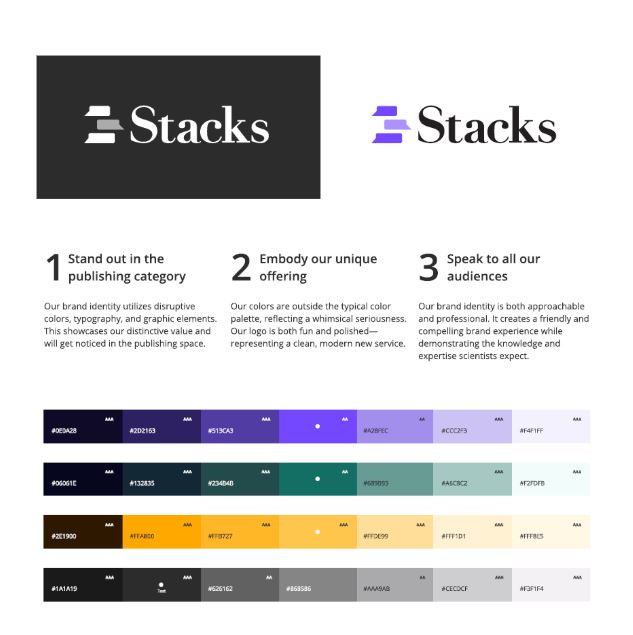
The brand was built on three goals: stand out in the publishing category, carry the offer’s mix of warmth and rigor, and speak to every audience at once, from early-career authors to journal societies.
Branding started the day after kickoff. Over the next five weeks we moved through initial concepts, logo alternatives and refinements to a finished brand book. The logo pairs three stacked speech bubbles with a classic serif wordmark: the bubbles are playful and the serif keeps the scholarly weight. The palette steps outside the usual publishing colors with four full scales, a violet primary, teal, amber and a warm neutral, and every swatch is labeled with its accessibility contrast rating. The client received a packaged brand kit with logos, icons and fonts on October 18, 2022, along with the brand and design files in Figma.
Designing the product and a site that launched in six weeks
Brand and product design ran side by side. We wireframed the journal’s core screens, revised them from the client’s feedback, then took them to high-fidelity designs and a second design pass.
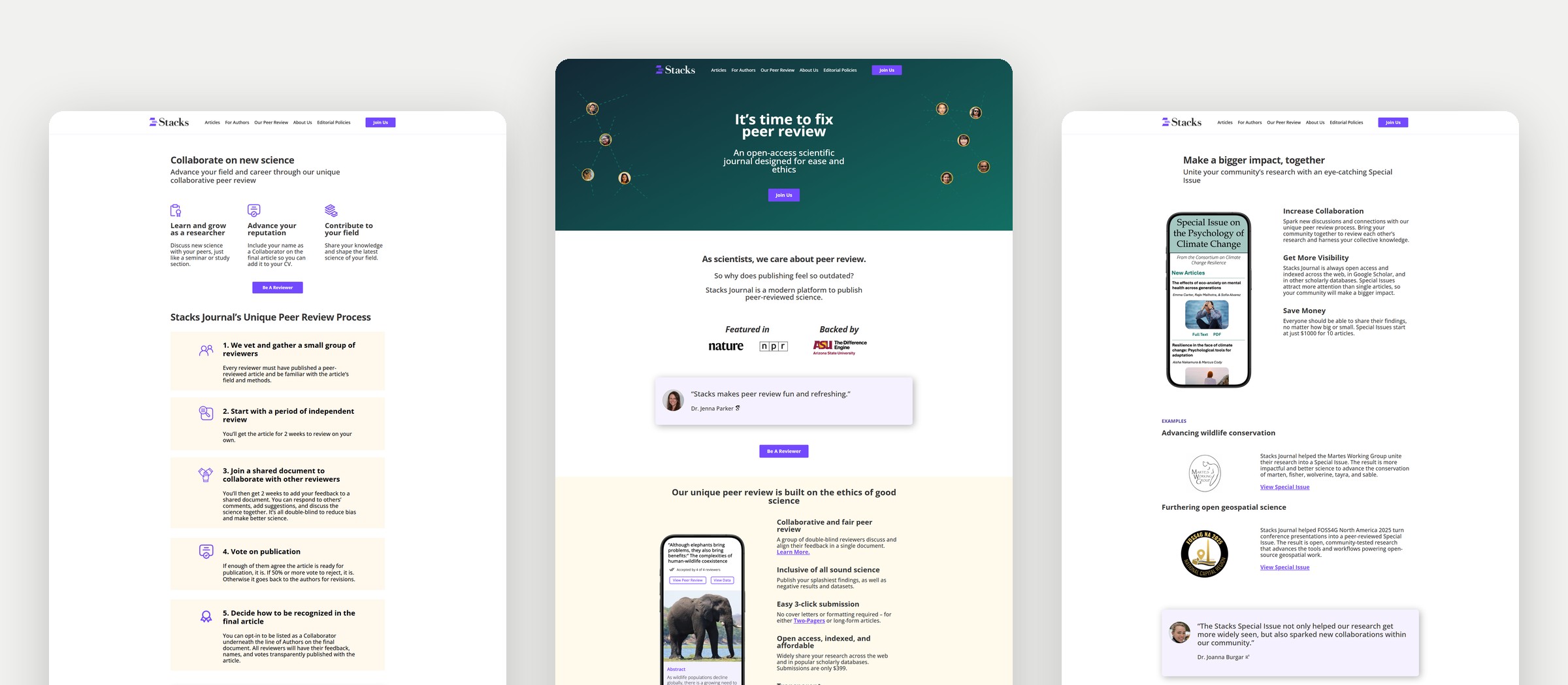
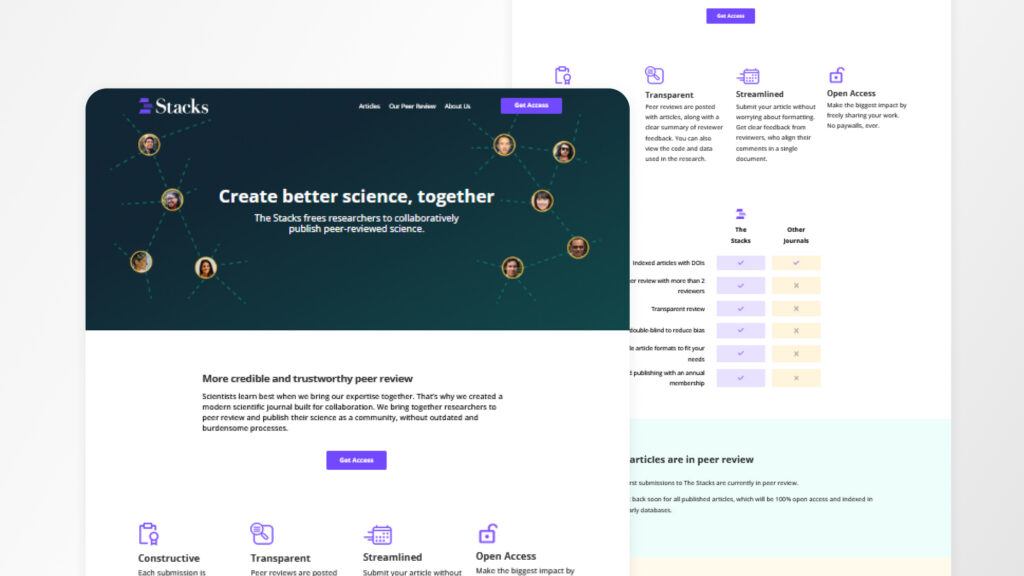
The marketing site came next. We designed a landing page and built it in WordPress on the Divi builder, with a hand-coded comparison table showing how Stacks differs from a traditional journal and fully responsive tablet and phone layouts. It went live on October 27, 2022, six weeks after kickoff. The following week we fixed launch bugs, tuned the mobile designs, started the on-page SEO, helped the client set up DNS and added Google Analytics.
Article pages built for published research
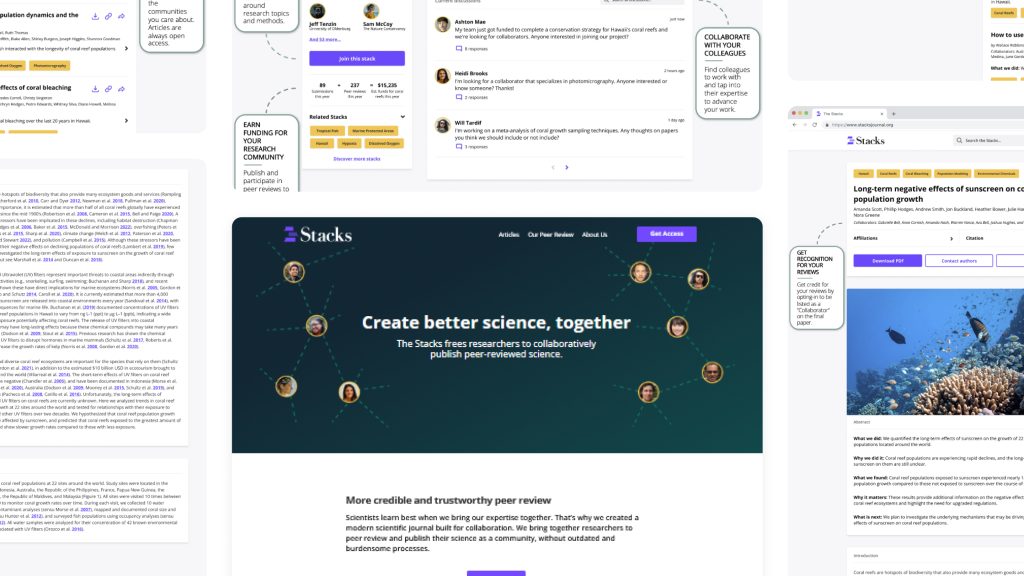
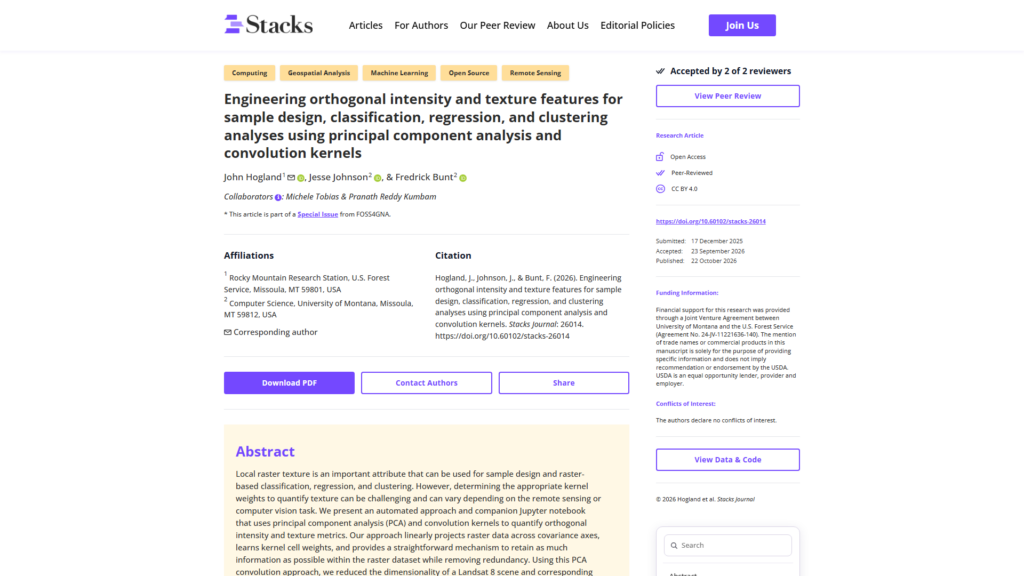
In June 2023, a year before the first articles appeared, Stacks came back to redesign the site and design how a published article would look. We produced new wireframes and high-fidelity designs, then rebuilt the site on a child theme with new templates, navigation, header, footer and a pricing comparison grid.
The article page was the center of that work. We designed the page itself, plus a PDF and Google Doc layout so every article has a downloadable version that matches it. The build added a sticky header, a share panel, a pop-up viewer for figures and a sidebar, followed by rounds of QA on desktop and mobile before handoff in September 2023.
What happened next
Stacks Journal published its first articles in July 2024 and has published 29 since, 14 of them in 2025. It has run two Special Issues: one for the Martes Working Group on marten, fisher and wolverine conservation, and one turning FOSS4G North America 2025 conference talks into peer-reviewed research. The site now lists coverage in Nature and NPR, backing from Arizona State University’s The Difference Engine, indexing in Google Scholar, Crossref and OpenAlex, and authors from institutions including UC Berkeley, Cornell, NOAA and the USDA.
We have stayed on as the journal’s web partner since. In 2025 we moved the site to new hosting with the DNS, SSL and redirect changes, and we handle plugin updates, backups and content edits as the journal grows.
If you are launching a product that needs a brand and a website people trust from day one, see our UX and product design work or talk to us about your site.