
You copy a paragraph out of Claude, paste it into a client document, make a few edits, and send it off. Nothing looks different.
But something came with it.
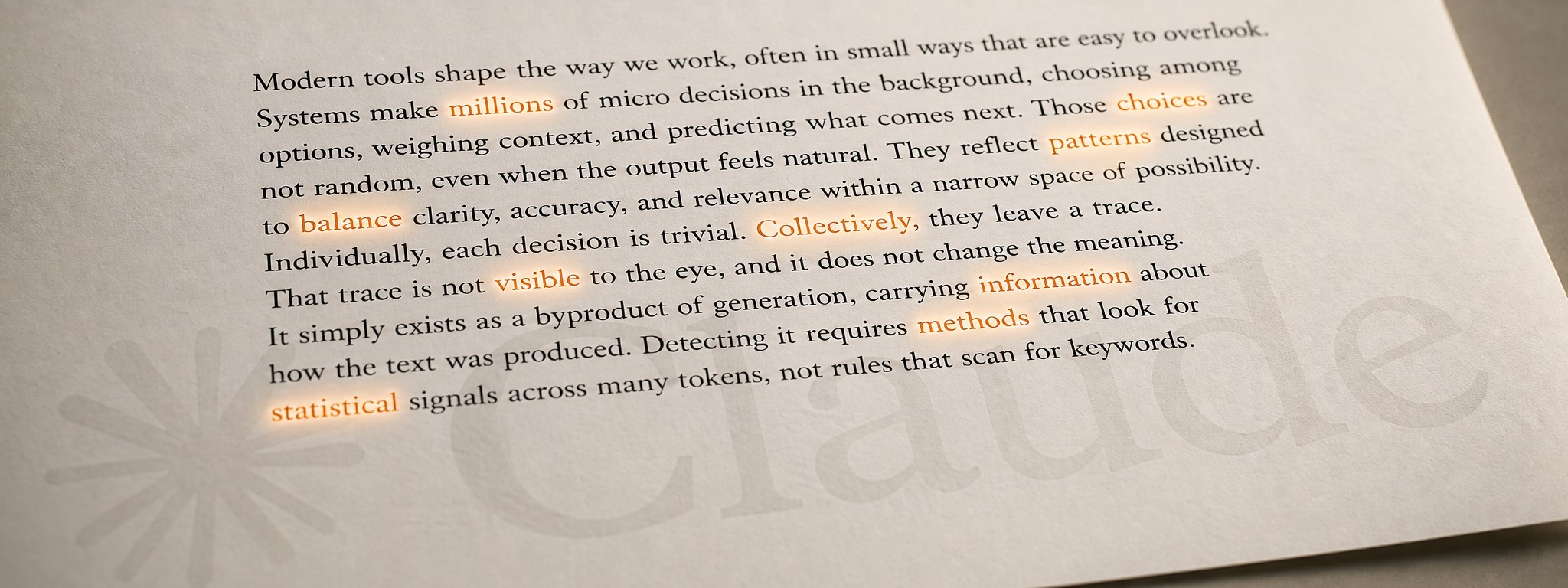
Every new Claude model now puts an invisible watermark into the text it generates. It survives copying and pasting, and in many cases it can survive editing too. You can’t see it, but a detector can potentially find it.
Anthropic turned this on for models launched on or after August 2, 2026, and it applies globally, not just in Europe. That means if your team uses Claude for blog posts, emails, product copy, documentation, or code, the output may now contain a signal identifying it as having passed through Claude.
For most businesses, this probably doesn’t change much. But it does raise some interesting questions about SEO, content ownership, AI detection, and what happens when Claude is built into your own products.
What is the Claude watermark?
The Claude watermark isn’t metadata hidden in a document or some invisible character added to the end of a paragraph. It’s a statistical pattern built into the text itself.
Anthropic applies the watermark while the model generates its response. The model slightly favors certain word or token choices in a pattern that can later be detected. Because that happens at the model level, the watermark isn’t tied to the Claude website or any particular application. It’s part of the generated text.
According to Anthropic’s own documentation on marking AI-generated content, the watermark is invisible to readers and doesn’t change the meaning, quality, or readability of the response. From a normal user’s perspective, Claude should work and write the same way it did before.
Files are handled differently. When Claude generates supported files such as SVGs, PNGs, or JPGs, Anthropic uses signed provenance metadata based on the C2PA open standard.
So there are really two systems: statistical watermarking for text and provenance metadata for supported files.
Why is Anthropic adding watermarks now?
The short answer is regulation.
Anthropic signed the EU AI Act’s Article 50(2) Code of Practice on Transparency of AI-Generated Content as a provider of both generative AI models and generative AI systems.
Article 50 requires providers to mark synthetic content in a machine-readable way when technically feasible. Those requirements became enforceable on August 2, 2026, which is also when Anthropic began applying its new marking system.
The law doesn’t require one specific watermarking technology. Providers can choose how they meet the requirement, which is why different AI companies have taken different approaches.
Anthropic also decided not to limit the change to Europe. The Claude watermark is applied globally wherever supported Claude models are offered. From an operational standpoint, maintaining one standard everywhere is considerably simpler than maintaining separate European and non-European versions of the models.
How does the Claude watermark work?
Anthropic hasn’t published all of the technical details behind its implementation, so there are limits to what we know. But the general approach to text watermarking is fairly well understood.
Claude text watermarking
Text watermarking works by influencing the model’s token choices as it generates a response.
A language model normally has several possible tokens it could reasonably choose next. A watermarking system can slightly favor particular tokens according to a hidden statistical pattern. The resulting text still reads normally, but enough of those choices across a longer passage can create a detectable signal.
Length matters.
A single sentence may not contain enough information to reliably detect anything. A 1,500-word article gives the system much more data to work with.
Because the watermark exists in the actual word choices, copying and pasting the text doesn’t remove it. Some editing may not remove it either. As more of the text is rewritten or paraphrased, however, the original statistical pattern becomes weaker.
Claude file watermarking and C2PA
Files use a different approach.
For supported generated files, Claude attaches signed C2PA provenance information showing that the file passed through Claude. That record can also help identify whether the provenance information has been modified.
The advantage of metadata is that it can provide much more information about where a file came from.
The disadvantage is that metadata is relatively easy to lose.
Take a screenshot, convert the file to another format, or run it through certain editing workflows and the metadata may disappear. That’s one reason watermarking and provenance metadata are increasingly being used together rather than treated as interchangeable technologies.
Where does the Claude watermark appear?
Because the watermark is implemented at the model level, it isn’t limited to Claude’s consumer application.
Anthropic says marking applies across the Claude Platform API, Claude app, Claude Code, Claude Cowork, and Claude Tag.
It can also apply when supported Claude models are accessed through cloud platforms such as AWS, Google Cloud, or Microsoft Foundry. File provenance support may vary depending on the platform and workflow.
The main exception right now is older Claude models.
Models released before August 2, 2026 fall under a transition period in the EU AI Act. Anthropic says it is working on adding marking support to those models as well.
Detection is also still developing. Anthropic has committed to helping third parties identify its marks, but as The Register noted in its coverage of the announcement, the broader detection tools and technical documentation are not yet available.
What can the Claude watermark actually tell you?
This is probably the most important distinction in the entire discussion.
Finding a Claude watermark does not prove that Claude wrote something.
It means the content may have been processed by Claude.
That’s a significant difference.
Someone could write an article entirely themselves and then ask Claude to proofread it. They could use Claude to translate it, shorten it, restructure it, or clean up the grammar. The resulting text could still contain Claude’s watermark even though the underlying work came from a person.
The opposite is also true. Failing to detect a Claude watermark doesn’t prove something was written by a person.
There are several reasons the watermark might not be detectable:
- The content came from an older Claude model.
- Someone substantially rewrote or paraphrased the text.
- The passage is too short to produce a reliable signal.
- File metadata disappeared during conversion, editing, or a screenshot.
- The platform or file format didn’t support that particular type of marking.
The useful way to think about the Claude watermark is as a signal, not proof.
That’s especially important if companies, schools, or other organizations begin using watermark detection for plagiarism, hiring, disciplinary decisions, or content enforcement. Detection alone doesn’t tell you enough about how the content was created.
Will the Claude watermark hurt SEO?
There is currently no evidence that having a Claude watermark directly hurts SEO.
Google’s published position on AI-generated content has generally focused on the quality and purpose of the content rather than whether a person or AI system typed the words.
What Google does target is scaled content abuse: large amounts of low-value content created primarily to manipulate search rankings.
That distinction matters.
A useful article containing original research, first-hand experience, expert analysis, or information that isn’t available everywhere else doesn’t suddenly become bad content because Claude helped write or edit it.
The same is true in the other direction. Publishing hundreds of lightly modified AI-generated pages doesn’t become a bad strategy because Google can detect a watermark. It was already a bad strategy.
There are still a few larger changes worth paying attention to:
| What’s changing | Why it matters |
|---|---|
| More AI providers are adding provenance signals | Identifying AI involvement is becoming easier |
| Google is bringing C2PA and SynthID verification into Search and Chrome | Provenance information is moving closer to the end user |
| Recent search updates continue emphasizing originality and information gain | Thin or derivative content has less room to compete |
For SEO teams, the practical advice hasn’t really changed.
Use AI to help produce better work, but make sure the final page contains something worth ranking. Add original information, first-hand experience, real examples, research, screenshots, interviews, analysis, or expertise. That’s the same principle behind our SEO and digital marketing work: the page has to earn the position on its own merits.
The Claude watermark itself isn’t the SEO problem. Low-value content is.
Building a product with Claude? This matters more
For companies using Claude inside their own software, the situation gets more complicated.
If you deploy Claude as part of your own product, the EU AI Act may classify your company as a deployer. That can create transparency obligations for you separately from Anthropic’s obligations as the model provider.
In other words, Anthropic watermarking Claude’s output doesn’t necessarily satisfy your responsibilities.
If your product includes an AI chatbot, voice agent, writing tool, support system, or another customer-facing AI feature, it’s worth reviewing how those interactions are disclosed to users. This is the same category of vendor and jurisdiction risk we worked through in our breakdown of whether Kimi AI is safe for developers, and it tends to surface late, usually right before a launch.
Reported penalties for transparency violations under the EU AI Act can reach €15 million or 3% of global annual turnover, which makes this something companies should review rather than assume their AI vendor has handled for them.
A few practical things are worth checking now:
- Inventory the customer-facing parts of your product that generate or display AI content.
- Check which Claude models you’re currently using and when they were released.
- Review the disclosure language users see when interacting with AI-generated content.
- Check whether your image and file pipelines preserve or strip C2PA metadata.
- Watch for Anthropic’s detection documentation and decide whether verification needs to become part of your workflow.
If that audit turns into real work, our AI consulting and development team does this kind of review for custom web and mobile applications regularly.
Claude watermark vs. SynthID and C2PA
Anthropic isn’t the first AI company to tackle this problem.
Google DeepMind developed SynthID and has open-sourced its approach to text watermarking. Google says more than 100 billion images, videos, and audio files have been watermarked with SynthID since 2023. Verification is already available through Gemini, with additional support announced for Search and Chrome.
OpenAI has also taken a layered approach, using C2PA Content Credentials alongside SynthID watermarking for supported images. In July 2026, it also expanded audio watermarking and introduced a verification API.
Across the industry, a pattern is starting to emerge.
Cryptographic metadata provides detailed provenance when the metadata remains attached. Invisible watermarking provides another signal that can potentially survive when metadata gets stripped.
Anthropic is following the same general approach, although as coverage of the rollout has pointed out, text remains one of the harder formats to watermark reliably. Text can be paraphrased, translated, shortened, expanded, or mixed with other writing, all of which can weaken the original signal.
What should content teams do about Claude watermarks?
For most content teams, Claude’s watermark doesn’t require a major change in workflow.
It does make a few existing best practices more important.
Keep a real editorial process. AI-generated content should still be reviewed, corrected, rewritten, and shaped by someone who understands the subject. That’s good editorial practice regardless of watermarking.
Add information that isn’t already everywhere else. Original data, interviews, screenshots, first-hand experience, internal knowledge, and expert analysis are increasingly important for SEO. AI can help organize that information, but it can’t invent genuine experience. Our generative AI content production work is built around that split.
Handle disclosure deliberately. If regulations, clients, or your audience require AI disclosure, establish a policy instead of relying on whether the content can be detected.
Don’t treat watermark detection as proof. Both false positives and false negatives are possible, especially once content has been edited or passed through multiple systems.
Review your process periodically. Anthropic’s detection tools, Google’s verification systems, and the transition rules for older models are still developing. The same is true of the tooling underneath, which is why AI automation projects tend to fail in production rather than in the demo.
The bottom line
The Claude watermark is best understood as a provenance signal. It can tell a detector that Claude may have been involved in producing or processing a piece of content. It can’t reliably tell you who originally wrote it, how much AI was involved, or whether the final work is good.
For most businesses and content teams, that doesn’t require a major change in strategy.
The same things that made content worth publishing before still matter now: original information, actual expertise, useful analysis, good editing, and something worth saying.
A watermark doesn’t make strong content weak. And removing one won’t make weak content strong.
If you’re working through what AI provenance means for your own site, product, or content program, get in touch with SLIDEFACTORY. We build AI workflows and SEO programs for companies that have to live with the results.
If the watermark question has you rethinking how much of your pipeline should lean on AI tooling in the first place, our comparison of Claude Code vs Webflow vs WordPress looks at what the agentic stack actually replaces.