
Every tool in this list was opened and checked on August 17, 2026. Free-tool lists go stale quietly; the verification date on each entry below is your guarantee this one has not.
If you run a business that depends on local customers, showing up in local search results is how people find you. Most small businesses do not have the budget for an agency engagement, and the honest truth is that a lot of the highest-leverage work can be done with free local SEO tools and consistency.
This article covers the eight free tools we actually use, what each free tier includes exactly, and what to check with each one in 2026.
What Is Local SEO and Why It Matters
Local SEO is the work of showing up when someone nearby searches for what you do: “plumber near me,” “dentist portland,” “commercial printer.” For brick-and-mortar stores it drives foot traffic; for service-area businesses it puts you in front of people at the moment they need you. The center of gravity is the local map pack and your Google Business Profile, backed by your website.
It is also the most level playing field in search. A small business with an accurate, active profile and a steady review habit can outrank a national chain in its own neighborhood, because local ranking runs on relevance, distance, and prominence rather than on domain size alone.
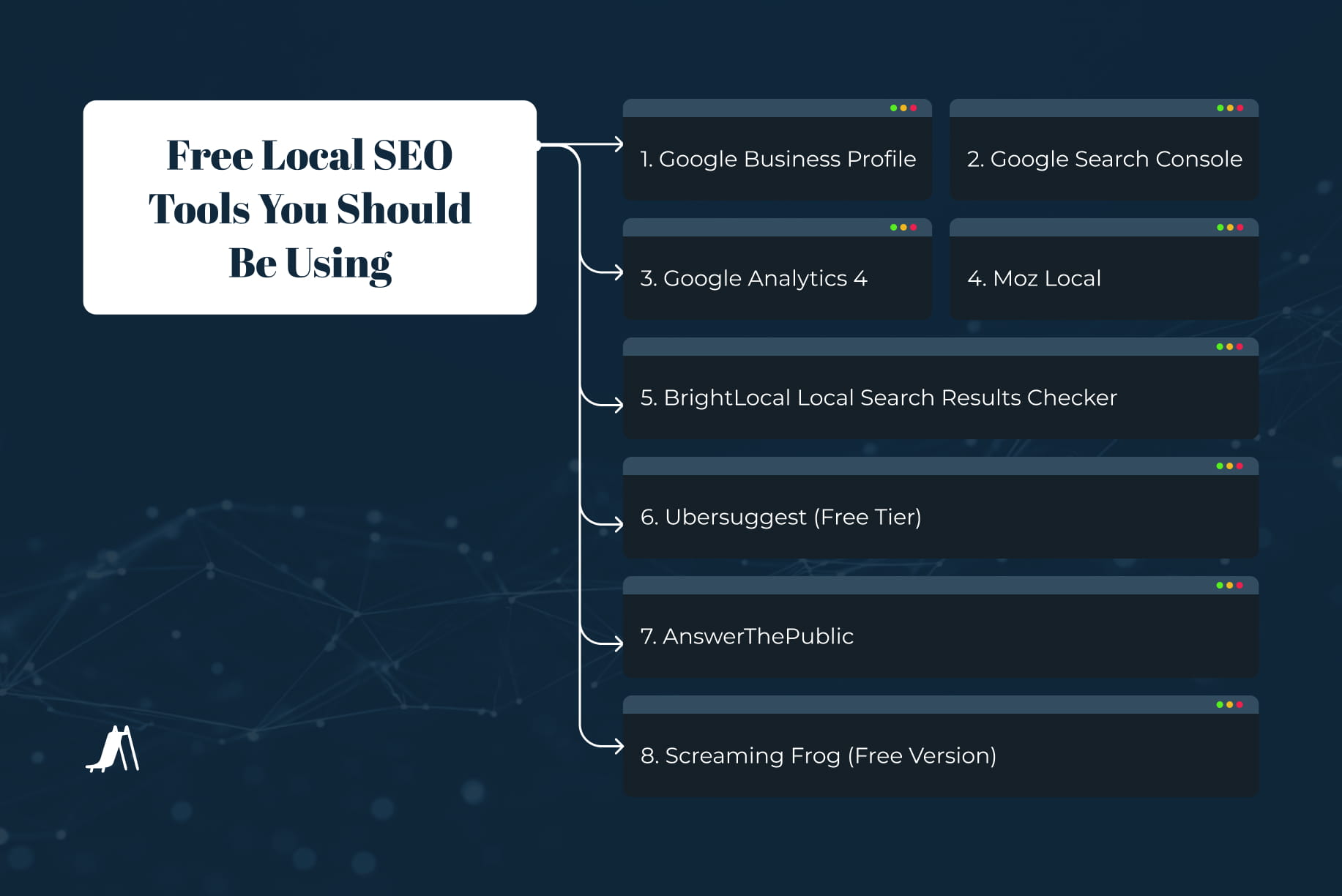
The free local SEO tools below split into three jobs: managing what Google knows about you (Business Profile), measuring what is happening (Search Console, Analytics, the SERP checker), and finding what to build next (keyword and question research, plus a technical crawl). You do not need all eight on day one. Start with the first two entries and add the rest as questions come up.
Free Local SEO Tools You Should Be Using
1. Google Business Profile
Your free storefront on Google Search and Maps, and the single most important local SEO asset you control. For map searches it effectively is your homepage: many searchers will call, book, or get directions without ever visiting your website.
What the free tier includes: everything. Listing management, posts, review replies, and the Performance report (formerly called Insights) showing calls, direction requests, and website clicks. Get started at business.google.com. Once the profile exists, ranking it is its own discipline; our Google Maps SEO guide covers that playbook.
What to check in 2026: hours and services first. Whitespark’s 2026 ranking factors survey (expert opinion, not a Google statement, but the field’s canonical annual survey) moved business hours to the fifth most important local ranking factor, and profile services rose 75 places. Complete every attribute, keep holiday hours current, and list each service as its own entry.
One caveat when you read the Performance report: calls are declining across the board for structural reasons. Google’s AI-generated local packs carry no call button, and a tracked Sterling Sky sample of 179 profiles showed clicks-to-call falling over two years while website clicks held steady. If your calls are down but direction requests and website clicks are flat, the surface changed; it does not automatically mean your visibility did. Last verified: August 17, 2026.
2. Google Search Console
Google’s own report on how your site performs in search: which queries show your pages, where you rank on average, and what gets clicked.
What the free tier includes: everything; there is no paid tier (search.google.com/search-console). Search performance by query and page, the Page indexing report showing what Google has and has not indexed, and alerts for indexing problems.
What to check in 2026: which local queries already drive impressions, because those are the terms worth strengthening first. And one specific audit: since an August 2024 change that local SEOs call the diversity update (documented by Sterling Sky and still in effect in 2026), Google can demote your organic result when the same URL also holds a map pack spot. If your Business Profile links to your top organic page and that page’s clicks have slipped, compare the two surfaces in Search Console before assuming a penalty. Last verified: August 17, 2026.
3. Google Analytics 4
Website analytics: where visitors come from, what they do, and which pages convert.
What the free tier includes: everything a small business needs. Geographic reports, traffic sources, and conversion tracking for the actions that matter locally, like calls, form fills, and direction clicks.
What to check in 2026: score your local work on leads, not sessions. A profile and site that generate twelve calls and form fills a month are outperforming ones with triple the pageviews and none. Last verified: August 17, 2026.
4. Moz’s Free Citation Checker
A one-off check of how your business name, address, and phone number (NAP) appear across major directories and data aggregators.
What the free tier includes: the listing check itself, under “Check My Presence.” Be clear about the boundary: Moz Local, the full product that manages and syncs listings for you, is paid. The free checker shows you what is wrong; fixing each listing is manual work you do yourself.
What to check in 2026: that your NAP is character-for-character identical everywhere, and that old addresses from any moves are gone. Inconsistent listings quietly undermine everything else on this list. Last verified: August 17, 2026.
5. BrightLocal’s Free Local SERP Checker
Shows you the actual Google and Google Maps results from any location: a city, a ZIP code, a neighborhood.
What the free tier includes: the checker runs free with no signup, with search term, location, country, and language options. BrightLocal’s full platform is paid, but this tool alone answers a question nothing else on this list can.
What to check in 2026: your rankings from where your customers are, not from your own desk. Map results are position-dependent, so a “we’re number two!” check from your office means little. Spot-check the neighborhoods you serve. Last verified: August 17, 2026.
6. Ubersuggest
Keyword research: search volumes, difficulty scores, related terms, and content ideas.
What the free tier includes: a free account gets a limited number of searches per day, enough for a small business that researches in focused sessions rather than all day. Basic site audit features are included.
What to check in 2026: the question-shaped searches around your services. “Service plus city” terms are usually obvious; the questions people ask before buying are where free keyword research actually earns its keep. Last verified: August 17, 2026.
7. AnswerThePublic
Visualizes the real questions people ask around a keyword, pulled from autocomplete and search data.
What the free tier includes: three searches per day on a free account. That is a real limit, so make them count: one seed term per session, exported before you close the tab.
What to check in 2026: this tool quietly became more interesting. Its sources now include YouTube, Amazon, and ChatGPT alongside Google, which means it shows you what people ask AI assistants, not just what they type into a search box. If you are thinking about how your business shows up in AI answers, this is the free end of that work; generative engine optimization is the deep end. Last verified: August 17, 2026.
8. Screaming Frog SEO Spider (Free Version)
A desktop crawler that audits your website’s technical health the way a search engine sees it.
What the free tier includes, exactly: crawls up to 500 URLs and finds broken links, redirect problems, missing or duplicate titles and meta descriptions, hreflang issues, and exact duplicate pages, plus XML sitemap generation and site visualisations. Worth stating plainly because tool lists often oversell it: JavaScript rendering, structured data validation, spelling checks, crawl comparison, and the Analytics and Search Console integrations are all paid-licence features. For a site under 500 URLs, the free tier covers the basics that matter.
What to check in 2026: your location and service pages. Broken links and duplicate titles on the pages your Business Profile depends on are the highest-cost technical problems in local SEO. While you are in there, confirm your LocalBusiness schema markup matches your profile exactly. Last verified: August 17, 2026.
When Free Tools Stop Being Enough

Free local SEO tools cover more of the job than most businesses ever use. If you are just starting, in a market with modest competition, or you simply want to learn the work, the list above plus consistency is a real strategy, not a consolation prize.
The honest boundary is time and prioritization, not tool quality. Free tools tell you what is wrong. They do not tell you which of the twelve things to fix first, and that ordering is most of the value of a paid engagement. The other common trigger is competition: when every rival in your market is doing the basics too, the differentiating work (content, local links, review velocity at scale) starts to demand hours that an owner-operator does not have.
A note on paid local SEO software, since it is the middle step people ask about. Platforms like BrightLocal, Moz Local, and Whitespark charge roughly what one hour of agency time costs per month, and what you are buying is mostly automation of things this list does manually: grid-based rank tracking instead of one-off SERP checks, listings sync instead of hand-editing directories, and review monitoring across sites. If the free versions of their tools are earning their keep, the paid tiers are usually the next honest dollar; software does not, however, decide what to fix first any more than the free tiers do.
If you do hire help, either way, bring your data. The history in your Search Console and Business Profile accounts makes any competent engagement faster and cheaper to start.
What None of These Tools Can Show You Yet
Two things changed in 2026 that no tool on this list measures. Google now shows AI-generated local packs on roughly 7% of tracked mobile queries in the US, per Sterling Sky’s tracking; those packs surface one or two businesses instead of three and have no call button. And Ask Maps, the conversational layer Google added to Maps in March 2026, personalizes its answers to each searcher, which means there is no position to track, with any tool, free or paid.
The response is not a new tool; it is the boring work above. Complete profiles with accurate hours and attributes are what AI surfaces draw on. If you want the wider version of that argument across all AI search, that is what generative engine optimization covers.
Common Pitfalls When Using Free SEO Tools
- Misinterpreting data: a keyword can have high volume and zero buying intent. Cross-check what a term is actually asking for before you chase it.
- Not tracking over time: a one-off audit is a snapshot. The value is in the trend, so re-run your checks monthly and keep the exports.
- Ignoring mobile and local intent: most local searches happen on phones, mid-errand. If your site is slow on mobile, the rest of this list is working uphill.
- Neglecting offline consistency: your signage, invoices, and voicemail should match your listings. Inconsistency confuses customers and search engines alike.
- Tunnel vision on keywords: reviews, page speed, and genuinely useful content move local visibility at least as much as another keyword pass.
What to Expect, Honestly
Profile completeness fixes can show up within weeks. Review velocity and content signals compound over months. Nobody can tell you a date, and anyone who does is guessing. What you can control is whether the boring monthly work happens: hours current, reviews answered, photos added, one audit re-run.
Where to Start
Do two things this week. Claim and completely fill out your Google Business Profile, with every attribute and accurate hours, because that is where the 2026 ranking data says the weight is. Then run Moz’s free citation check and fix whatever it finds. Everything else on this list builds on those two.
And when you hit the boundary where the free toolkit stops answering your questions, that is a real signal, not a failure. It usually means the basics are done and the next gains are in work that takes hours you do not have. We are happy to tell you honestly which side of that line you are on.