Most local SEO checklists give you 50 or 60 things to do and leave you to guess which ones matter. You update a directory listing, add a few photos, rewrite a title tag, and still have no idea whether you are fixing the right problem or just staying busy.
The order is the part that matters. There is no value in building citations before correcting an old address, or in asking for reviews while your Google Business Profile is half empty. Each part feeds the next, so the work has to happen in sequence.
This is the checklist we work through with our own local SEO clients: 26 items across seven steps, in the order we do them. Your Google Business Profile does most of the work in the map pack. Your website supports that profile and competes in the organic results below it. The two share signals, which is why treating them as separate projects leaves results on the table.
None of it is clever. The local businesses that win are the ones that finished the unglamorous parts while their competitors went looking for shortcuts.
The Local SEO Checklist, in Order
If you take one thing from this guide, take the sequence.
- Settle your name, address, and phone number, then decide which page ranks for each service.
- Complete the Google Business Profile: categories, services, hours, attributes, photos, website link.
- Improve the page the profile links to so it ranks and converts on its own.
- Fix listings that disagree with each other before creating new ones.
- Build a review process your team will still be running in month six.
- Earn a small number of local links that could send a real visitor.
- Measure calls, leads, and queries instead of screenshots of your own rankings.
What Local SEO Includes, and What Google Ranks
Local SEO is often sold as a package without anyone explaining what is inside it. The work comes down to five connected areas: your Google Business Profile, the website pages that support it, the listings that confirm who and where you are, the reviews that establish prominence, and the links that build the site’s authority. If a proposal contains work that maps to none of those five, ask what it is meant to accomplish.
Google names three local ranking factors: relevance, distance, and prominence. Relevance is how well your profile matches the search, distance is how far you are from the searcher, and prominence is how well known Google thinks you are, drawn from reviews, links, and citations. Every item below moves relevance or prominence. Distance is the one you cannot move, so you work around it by being clearly better on the other two.
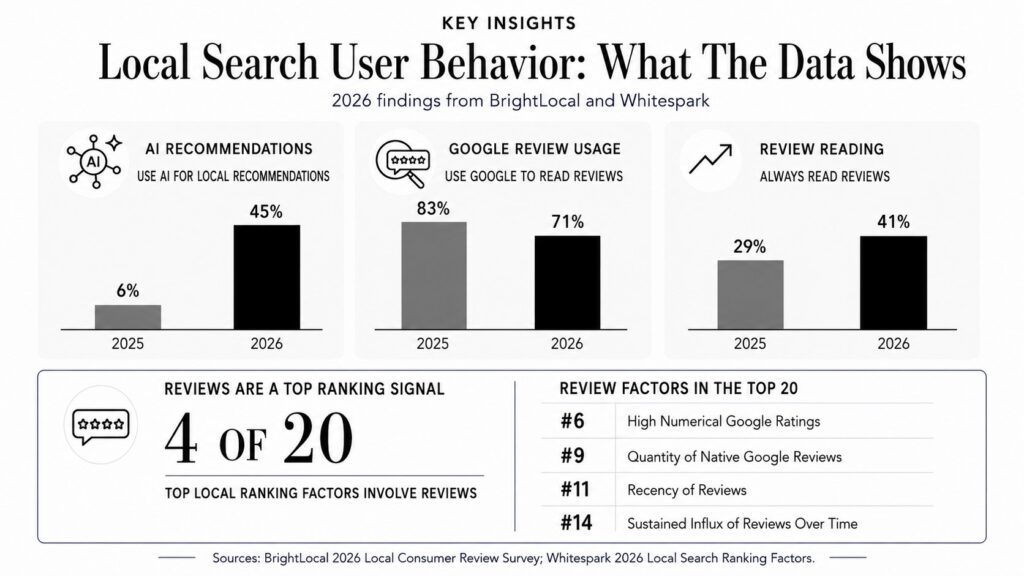
Local search behaves differently from an informational search. Someone looking for a plumber or an attorney nearby is frequently ready to contact a business that day, and much of that contact happens inside the map pack without a website visit. That is why local performance is measured in calls, messages, and direction requests rather than traffic.
It is also not the answer to every visibility problem, and it will never justify a retainer that repeats the same citation work indefinitely. This checklist has an endpoint, and a good provider will tell you when you have reached it.
1. Two Decisions, Before Any Tactics
Decisions, not tasks. Skipping them creates rework through everything that follows.
- Choose one canonical name, address, and phone number. Exactly as it will appear everywhere, down to “Suite” against “Ste” and whether the legal entity name is included. Every profile and citation copies this one string. Change it halfway through and you will spend months hunting mismatched listings.
- Decide which single page should rank for each service. One page per thing you sell, chosen before you optimize anything. Two of your own pages targeting the same service and city compete with each other, which is self-inflicted and harder to unwind than to avoid.
2. Complete the Google Business Profile, Field by Field
The highest-leverage step on this list, and it is free. Most businesses fill in the minimum and never return. Finishing these six puts you ahead of a surprising number of competitors before you touch your website.
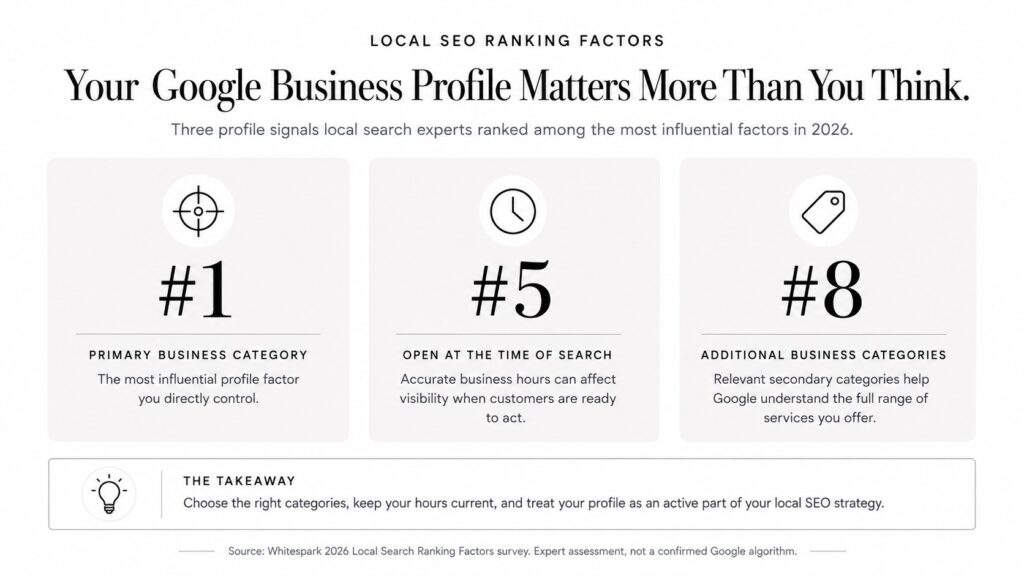
- Select a specific primary category. “Web design company”, not “Consultant”. You get exactly one, and it is the strongest relevance signal you directly control. Add additional categories that genuinely describe the business, and none that you added only to appear in more searches.
- Enter services one at a time, each with its own description. A single “we do everything” entry gives Google nothing to match against a service-and-city search. In Whitespark’s 2026 Local Search Ranking Factors survey, “keywords in GBP services” was the year’s biggest climber, up 75 places from #110 to #35.
- Keep hours accurate, including Special hours for holidays and temporary closures. Most businesses treat this as administration. The same 2026 survey puts “business is open at the time of search” fifth overall, and a separate factor, “proper hours set on GBP”, climbed 64 places to #21. That survey is expert opinion rather than a confirmed Google formula, but it is the field’s canonical one, and an inaccurate “may be closed” label costs the placement and the click.
- Complete every relevant attribute. Accessibility, payment options, appointment requirements, languages spoken. These are the fields conversational and AI-assisted local searches filter on. A blank attribute is not a skipped question, it is a filter your business fails.
- Use real photos, and keep adding them. Exterior, interior, team, finished work, work in progress. A smaller set of accurate photos beats stock images of an office that is not yours.
- Point the website link at the right page. Not reflexively the homepage. Send it to the page that matches the services and location that profile represents. This single line decides where every profile visitor lands.
There is more to the profile than six lines can hold, including how Google weighs the three factors and what the Ask Maps layer changed when it launched in March 2026. That is our Google Maps SEO guide.
3. Improve the Page the Profile Links To
The profile earns the placement. The page turns it into business and competes in the organic results underneath, so it needs to do more than repeat your business name above a contact form.
- Name the service and the place once each, in the title tag and the H1. In the words a customer would use. Once is enough. Repeating the city throughout the page makes the copy worse for the visitor and does not turn a weak page into a strong one.
- Put the address and phone number in the page as readable HTML text. The same canonical string from step one, not locked inside an image, a third-party widget, or a script that loads late.
- Add LocalBusiness structured data that matches the visible page. At minimum name, address as a PostalAddress, telephone, openingHoursSpecification, and sameAs pointing at your profiles. Structured data clarifies what a visitor can already see. Markup describing content that is not on the page is a violation, not a shortcut.
- Build internal links to the page. From relevant posts, service pages, case studies, and location content you already own. Internal linking is the one ranking input you control completely, and it is the one most sites underuse.
- Add evidence only your business could provide. A named project, original photos, pricing guidance, a number out of your own operations. If the page could be dropped onto a competitor’s site without anyone noticing, it needs more substance.
4. Fix Citations and NAP Consistency
Citations are mentions of your name, address, and phone number across the web. They confirm the business is real and consistently located, and more of them is not better.
- Correct duplicates and wrong data before creating anything new. An old address or a disconnected number does more damage than a listing you never made.
- Cover the first-party platforms, then your industry’s directories. Apple Business Connect and Bing Places first, then the trade association or professional directory your field actually uses. One of those is worth more than another generic listing site.
- Stop at consistency. Thirty accurate citations beat 200 listings split across three phone numbers and two versions of the business name.
Being blunt about this step: citations are table stakes, and the ceiling is low, because a competitor can buy the same directory distribution in an afternoon. There is also evidence the wider category is weakening. In Search Engine Land’s dataset for the March 2026 core update, which ran 27 March to 8 April, 24.1% of pages ranking in the top ten fell out of the top 100 entirely, against 14.7% in the December 2025 update, and aggregators, directories, and comparison sites led the categories that lost ground. Listings still confirm who and where you are. They are not a growth strategy.
5. Build a Review Process, Not a Campaign
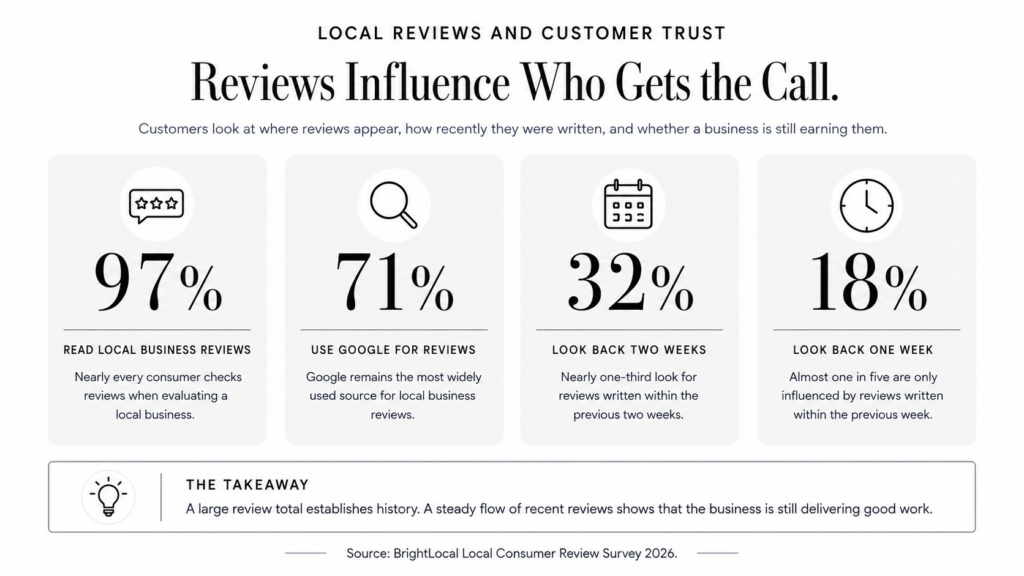
Reviews carry prominence and conversion at once, and they show a customer the business is active right now. The goal is a process your team keeps running, not a push that dies in month two.
- Ask at delivery, the same way every time. The moment the work lands is when the customer is most positive, so make the request part of the handoff rather than something you remember when the review count looks thin.
- Ask the customer to describe the work. “What did we help you with?” produces specific answers, and customers name the service and the neighborhood in their own words. That is the only acceptable way that language gets there.
- Respond to every review, briefly. Including the negative ones, acknowledged without a public argument.
- Never buy reviews and never gate who gets asked. Asking only satisfied customers for a public review violates Google’s policy, and the exposure is the profile itself, not a temporary ranking change.
6. Earn Local Links Worth Having
Local link building starts with the organizations already connected to the business, which produce the most relevant links and the hardest for a competitor to copy.
- Start with existing relationships. Suppliers, partners, clients, the association you pay dues to, the event you sponsored. If their audience has a real reason to find you, there is a real reason to link.
- Find unlinked mentions. Press coverage, partner pages, and client case studies often name a business without linking it. Asking someone to link a mention they already published is a far easier conversation than asking for a new one.
- Favor relevance over volume. One credible local link that sends an interested visitor beats dozens of directory links. If a link could never produce a visit or a lead, be honest about why you want it.
7. Measure the Results That Matter
Local rankings vary by neighborhood, device, and searcher, so a single ranking number is an average of readings that disagree with each other. Track the actions instead.
- Track the four numbers in your profile’s performance view: calls, messages, direction requests, and website clicks. Connect your forms and call tracking to analytics so you can tell which pages and which searches produced them.
- Read the Queries tab in Search Console. The words people actually used tell you which services and locations are gaining traction, and what to build next. A position number tells you none of that.
- Check map pack visibility across a grid of locations. Rankings change block by block, so a grid shows where you appear. A single search from the office shows where you appear from the office.
Two limits worth knowing. Local results are personalized, so a screenshot of your own search proves close to nothing about what a customer sees. And AI-generated local packs, which Sterling Sky’s 2026 tracking put at roughly 7% of tracked US mobile queries, name one or two businesses instead of three and carry no position to track: you are named or you are not. When rankings move and nothing on your end changed, check the date against Google’s own record before assuming the checklist failed. 2026 alone has had core updates in March and May, spam updates in March and June, and a Discover update in February, all published on the Search Status Dashboard. The wider problem of visibility inside AI answers is what generative engine optimization covers.
None of this needs an expensive software stack. We keep a current list of the best free local SEO tools that cover most of the work above.
When a Checklist Is Not Enough
A checklist is a floor, not a strategy. Three situations make a longer list the wrong answer, and knowing which you are in is worth more than another round of profile edits.
- Every strong competitor has already finished the basics. In a competitive metro the entire top of the map pack has complete profiles, current photos, and hundreds of reviews. From there the difference comes from content, links, brand demand, and site strength. That is broad SEO work, not local work.
- You are a service-area business, a franchise, or a multi-location company. Each carries rules this list does not cover, and mistakes create suspensions and duplicate profiles rather than a few lost positions.
- Your buyers are not searching locally at all. Some search by outcome or specialty instead of place. If that is how your best customers choose a provider, local visibility is not the right investment.
We work this list with clients in this order because it makes the gaps easy to see. We will also tell you when the checklist is finished, when the real constraint sits somewhere else, and when local SEO is the wrong lever entirely. That conversation is most of what you are paying a Portland SEO company for, and it costs nothing to have.