
By Mark Nguyen, CEO & Founder of SLIDEFACTORY – 20+ years in design, development, and emerging technology.
If your Portland small business website isn’t bringing in leads or sales, it’s not a brochure problem, it’s a design strategy problem. After spending more than a decade building and optimizing websites for businesses across Portland, from Old Town storefronts to Southeast service providers, I’ve seen the same seven design decisions separate sites that generate revenue from sites that just sit there. These aren’t theoretical tips pulled from a marketing blog. They’re the exact strategies we implement at SLIDEFACTORY for every client engagement, and they’re grounded in what actually works in Portland’s competitive local market.
Here’s what matters most – and why.
1. Build Mobile-First, Not Mobile-Friendly
There’s a critical difference between a website that technically works on a phone and one that was designed for a phone first. According to Statcounter’s 2024 data, mobile devices account for roughly 63% of all web traffic in the U.S. In Portland: where people browse on the MAX, search for lunch spots while walking down Hawthorne, and compare service providers from their couch. That number skews even higher for local business searches.
Mobile-first design means starting your layout, navigation, and content hierarchy on a small screen and scaling up to desktop, not the other way around. When you design for desktop first and then squeeze it down, you end up with tiny tap targets, text that requires pinching to read, and forms that are painful to fill out on a phone keyboard.
We learned this early on with a nonprofit in Portland. Their desktop site was strong, but most traffic was mobile and users were dropping off.
We rebuilt it mobile first with simplified navigation and clearer calls to action. The design stayed similar. The priorities changed.
Mobile engagement and conversions increased within weeks.
What mobile-first actually looks like in practice: readable text without zooming, thumb-friendly button sizes (minimum 44×44 pixels), images optimized for cellular connections, and forms that play nicely with smartphone keyboards. If your designer starts by showing you a desktop mockup, ask why.
2. Treat Local SEO as a Design Decision, Not an Afterthought
Most Portland businesses think of SEO as something you bolt on after the website is built. That’s backwards. The structure of your site, how pages are organized, what content lives where, how your location information is marked up in the code, determines how well you’ll rank for searches like “web design in Portland Oregon” or “best restaurant near me” before a single blog post is written.
Local SEO integration starts at the sitemap level. Your site needs location-specific page titles, properly implemented LocalBusiness schema markup, and a clean connection to your Google Business Profile. It also means creating content that targets real neighborhood-level searches, people in Portland don’t just search for “coffee shop.” They search for “coffee shop Alberta” or “web designer Southeast Portland.”
We worked with an orthopedic surgeon who had a well-designed site but limited visibility in local search. Without changing the visual design, we restructured the page hierarchy, added proper medical schema markup, created neighborhood-specific landing pages, and built out optimized service pages and blog content aligned with how patients search for shoulder and sports injury treatment.
Within a few months, the practice began ranking for competitive procedure-based terms in its market. The lesson: local SEO is architecture, not decoration.
3. Design for Trust, Not Just Aesthetics
Portland customers are discerning. They support businesses that feel real, and they can spot a generic template site from a mile away. But authentic design isn’t about slapping a picture of Mt. Hood on your homepage or using the same trendy fonts as every other Portland agency. It’s about building trust through specificity.
Trust-building design means showing real photos of your team and workspace (not stock photos), displaying genuine customer testimonials with names and context, being transparent about your pricing or process, and letting your actual personality come through in the copy. Portland’s business community is tight-knit: people talk, and they refer businesses that feel honest.
One of our more rewarding projects was helping build a Portland-based scientific journal designed for ease of use and ethical publishing standards. That platform is now used by researchers at leading institutions globally and has been featured in Nature and NPR. The design wasn’t flashy. It was clear, functional, and deeply trustworthy. Every element served the audience’s actual needs rather than trying to impress. That’s the principle that works for any Portland business, whether you’re publishing peer-reviewed research or selling handmade goods on Division Street.
Sustainability messaging also matters here, but only if it’s genuine. Oregon customers respond to real environmental commitments: certified B Corp status, specific waste reduction practices, concrete community partnerships. Vague “we care about the planet” language actually erodes trust rather than building it.
4. Speed Is a Revenue Lever, Not a Technical Detail
Google’s own research shows that as page load time increases from 1 second to 3 seconds, the probability of a visitor bouncing increases by 32%. At 5 seconds, it jumps to 90%. For a Portland small business that might get 500 website visitors a month, the difference between a 2-second and a 5-second load time could mean dozens of lost customers, every single month.
Speed optimization isn’t glamorous, but it directly impacts your bottom line. The main culprits for slow Portland business sites are oversized images (especially hero images that haven’t been compressed), bloated page builders with excessive JavaScript, cheap shared hosting, and no content delivery network.
The fix doesn’t have to be complicated. Proper image compression alone: serving WebP format, sizing images to their display dimensions, and lazy-loading below-the-fold content, can cut load times in half. Pairing that with a quality hosting provider and CDN gets most small business sites under 2 seconds.
We treat speed as a launch requirement, not a post-launch optimization. Every site we build goes through performance testing using Google’s PageSpeed Insights and Lighthouse before it goes live, and we monitor Core Web Vitals as part of our ongoing maintenance. If your current site scores below 70 on PageSpeed Insights mobile, you’re leaving money on the table.
5. Every Page Needs a Job
The most common mistake we see on Portland small business websites is pages without a clear purpose. A services page that describes what you do but doesn’t ask the visitor to take any action. An about page that tells your story but doesn’t link to anything. A blog post that ends without a next step.
Every page on your site should have one primary call-to-action and, ideally, one secondary option. For a service page, the primary CTA might be “Schedule a free consultation” with a secondary of “See our work.” For a blog post, it might be “Contact us about this” with a secondary of “Read the related guide.”
The design of these CTAs matters as much as the words. They need sufficient visual contrast to stand out from surrounding content, clear and specific language (“Get a free site audit” beats “Learn more”), and placement at natural decision points, not just crammed at the bottom of the page. We typically place CTAs after the problem statement, after the solution explanation, and at the page end.
Testing matters here too. We run simple A/B tests on CTA language, color, and placement for our clients. Small changes (swapping “Contact us” for “Get your free quote”) have produced conversion improvements of 20-40% on individual pages. The point isn’t to be pushy. It’s to make the next step obvious and easy.
6. E-Commerce Isn’t Optional Anymore
Portland consumers increasingly expect to transact online, even with local businesses. This doesn’t necessarily mean building a full online store. It might mean adding online appointment booking for a service business, gift card purchasing for a restaurant, or a simple product catalog with “buy now” functionality for a retail shop.
The key is reducing friction between “I’m interested” and “I’ve purchased.” Every extra click, every confusing checkout step, every moment of uncertainty about shipping or pickup options costs you conversions.
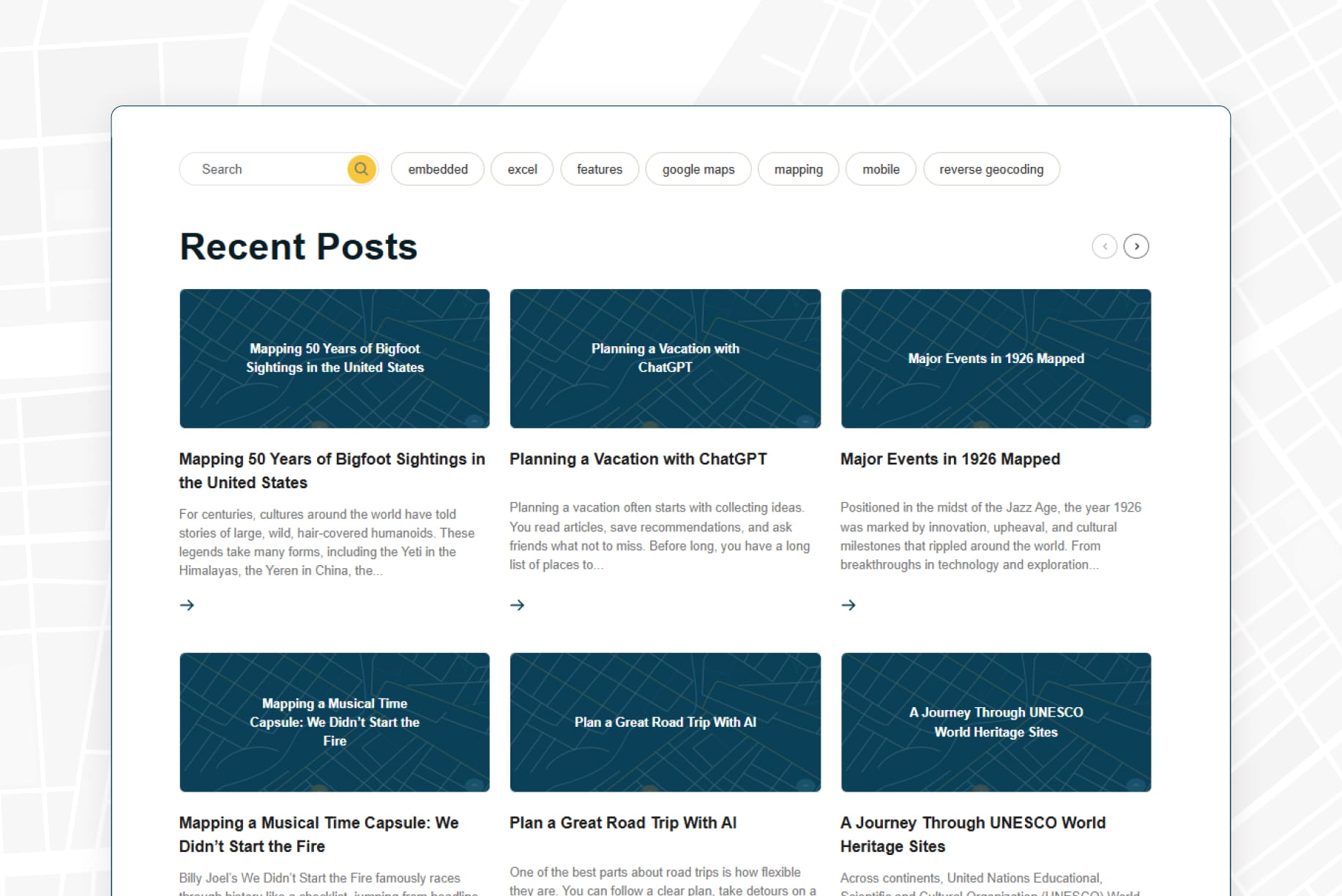
We recently modernized a blogging platform for a web-based tool that transforms spreadsheet data into interactive Google Maps. The original site was content-heavy but had no clear conversion path from “reading about the tool” to “using the tool.” By restructuring the user flow and adding strategic conversion points, we turned a passive content site into an active growth engine. The same principle applies to any Portland business: if people can learn about you online but can’t easily take the next step online, you’re losing them to competitors who’ve made that step easier.
For Portland specifically, local delivery and pickup options are a real differentiator. Customers here actively prefer buying from local businesses, give them a frictionless way to do it from their phone.
7. Maintenance Isn’t a Cost: It’s Protection
A website isn’t a one-time project. It’s a living system that needs regular attention to stay secure, fast, and effective. We’ve seen too many Portland businesses invest $10,000+ in a beautiful new site, then let it deteriorate for two years because they didn’t budget for maintenance.
At minimum, your site needs monthly security updates, regular backups, performance monitoring, and quarterly content reviews. Without these, you’ll accumulate security vulnerabilities, your page speed will degrade as plugins and platforms update around you, and your content will grow stale in Google’s eyes.
Professional maintenance typically runs $100-$300/month for a small business site, depending on complexity. Compare that to the cost of recovering from a security breach (average of $4,500+ for small businesses, according to Hiscox’s 2024 cyber readiness report) or the revenue lost during days of unexpected downtime. Maintenance is the cheapest insurance policy your business can buy.
We include proactive monitoring and maintenance in every client relationship because we’ve seen what happens without it. Sites break. Rankings drop. Customers bounce. It’s always cheaper to prevent these problems than to fix them after the fact.
What This Actually Costs and How Long It Takes
Professional web design for a Portland small business typically ranges from $5,000 to $20,000, depending on the complexity of your needs. A simple service business site with strong local SEO sits at the lower end. A full e-commerce build with custom integrations and ongoing optimization sits at the higher end. Be wary of quotes significantly below this range. They usually mean template-based work without the strategic thinking that drives actual results.
A realistic timeline looks like this: 1-2 weeks for strategy and discovery, 4-6 weeks for design and development, 1 week for testing across devices, and 1 week for launch and training. Rushed timelines almost always mean corners are being cut somewhere, usually in strategy or testing, which are the two phases that matter most.
When evaluating web design partners in Portland, look for a proven local portfolio with measurable results, not just pretty screenshots. Ask about their process for mobile testing, local SEO implementation, and ongoing support. And make sure you understand exactly what you’re getting, a website is only as good as the strategy behind it.
The Bottom Line
Your website works for your business 24 hours a day. It’s the first impression for most of your potential customers, and in Portland’s competitive local market, a mediocre site is the same as no site at all. These seven strategies aren’t aspirational, they’re the baseline for any small business that wants to compete online in 2025 and beyond.
If your current site isn’t generating leads, ranking in local search, or converting visitors into customers, one or more of these fundamentals is likely missing. The good news is that every one of them is fixable, and the ROI on getting them right is substantial.
Get in touch with our team if you want a straightforward assessment of where your site stands and what it would take to turn it into a growth engine. No pressure, no jargon, just an honest look at what’s working and what isn’t.
If you would rather have an experienced Portland team handle these fundamentals for you, see how SLIDEFACTORY’s Portland web design services approach revenue-driving websites end-to-end.