That mobile game you played during your lunch break? The augmented reality app that lets you place virtual furniture in your living room? The stunning animated short film you watched last week? There’s a good chance they all share something in common: they were built with Unity.
Unity 3D has quietly become one of the most influential pieces of software in the digital world, powering everything from indie passion projects to blockbuster entertainment experiences. But what exactly is Unity, and why has it captured the attention of creators everywhere?
Welcome to our Unity Basics series! Over the next several articles, we’ll guide you through everything you need to know about Unity, from understanding what it is and why it matters (this post) to hands-on tutorials that will have you creating your first interactive experiences. Whether you’re completely new to game development or looking to expand your creative toolkit, this series will give you the foundation you need to start building with Unity.
More Than Just a Game Engine
While Unity started as a game development platform, calling it “just a game engine” today would be like calling a smartphone “just a phone.” Unity has evolved into a comprehensive real-time 3D development platform that’s reshaping industries far beyond gaming.
Games are just the beginning. Unity powers mobile hits like Monument Valley and Hearthstone, console favorites like Ori and the Will of the Wisps, and VR experiences that transport you to other worlds. But step outside the gaming sphere, and Unity’s influence becomes even more impressive.
In architecture and construction, firms use Unity to create photorealistic building walkthroughs before breaking ground. Healthcare professionals train with Unity-powered medical simulations that let them practice procedures without risk. Automotive companies like BMW and Volvo use Unity to design car interiors and test them in virtual environments.
The film industry has embraced Unity for real-time animation and virtual production. Disney, Netflix, and major studios now use Unity to create animated content, preview scenes, and even film live-action sequences with virtual backgrounds, all rendered in real-time.
Education and training have been transformed by Unity-powered experiences. From NASA using Unity for space mission training to universities creating immersive historical experiences, the platform is making learning more engaging and effective.
Why Unity Resonates with Everyone (Despite Some Growing Pains)
Unity’s widespread adoption isn’t accidental, it’s the result of deliberate design choices that make it accessible to creators at every level. However, it’s worth acknowledging that Unity’s journey hasn’t been without controversy.
The elephant in the room: pricing changes. In late 2023, Unity announced a significant shift to its pricing model that would have charged developers based on game installations rather than just subscriptions. The backlash from the developer community was swift and severe, with many studios publicly threatening to abandon Unity entirely. Unity ultimately reversed most of these changes, but the incident highlighted the platform’s growing pains as it transitions from startup to major corporation.
Trust and transparency matter. The pricing controversy wasn’t just about money. It was about trust. Many developers felt blindsided by retroactive changes to their licensing agreements. Unity’s leadership has since apologized and committed to more transparent communication, but some developers remain cautious about building their futures on the platform.
Still, the fundamentals remain strong. Despite these challenges, Unity’s core strengths haven’t disappeared:
It speaks your language. Whether you prefer C#, visual scripting, or even no coding at all, Unity accommodates different skill levels and learning styles. Complete beginners can create functional prototypes using Unity’s visual scripting tools, while experienced developers can dive deep into custom code.
It works everywhere. Build once, deploy everywhere isn’t just marketing speak with Unity. Create your project on Windows, Mac, or Linux, then publish to over 25 platforms including iOS, Android, PlayStation, Xbox, Nintendo Switch, web browsers, and emerging platforms like Magic Leap.
The community has your back. Unity boasts one of the largest and most supportive development communities in tech. Stuck on a problem? Chances are someone has faced it before and shared the solution. The Unity Asset Store offers thousands of ready-made components, 3D models, audio clips, and scripts that can jumpstart your project.
Current pricing is reasonable. Unity Personal remains completely free for individuals and small businesses earning under $200,000 annually, making it perfect for learning and experimentation. Unity Pro, while subscription-based, offers professional features at competitive rates compared to other enterprise development tools.
Your First Steps into Unity
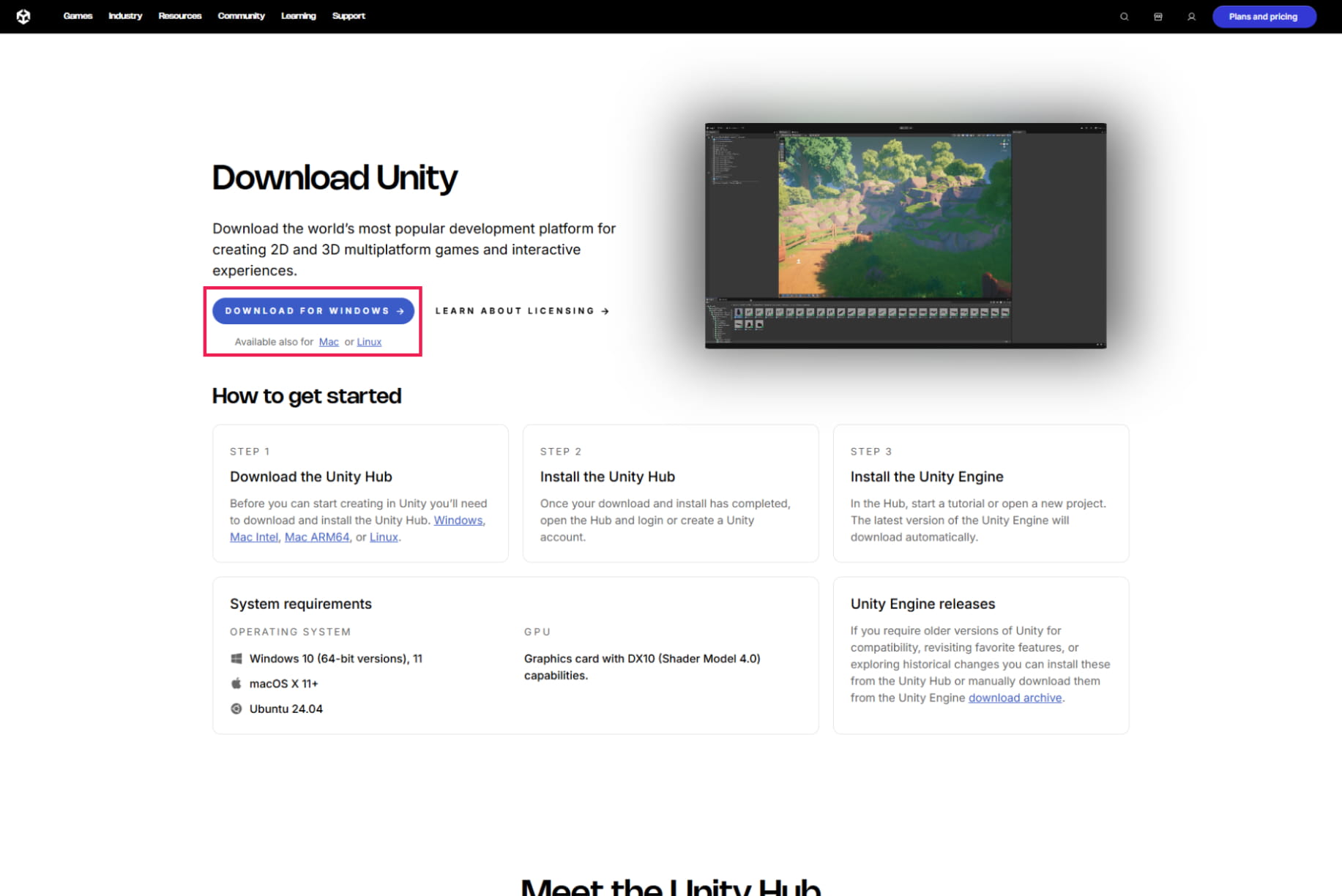
Curious to see what Unity can do? Getting started is surprisingly straightforward.
Download and explore. Unity Hub, the launcher application, makes installing Unity versions and managing projects simple. The software includes built-in tutorials that guide you through creating your first 3D scene, complete with lighting, physics, and interactivity.
Start with templates. Unity offers project templates for different types of experiences: 2D games, 3D games, VR apps, AR projects, and more. These templates provide a foundation you can build upon, complete with example scenes and scripts.
Learn by doing. Unity’s learning ecosystem includes free courses, documentation, and sample projects. The Unity Learn platform offers structured pathways for different skill levels and interests, from complete beginners to specialists in areas like VR development or technical art.
Join the conversation. The Unity community forums, Discord servers, and local meetup groups are invaluable resources for learning, networking, and staying updated on best practices.
Making an Informed Choice
Unity represents something bigger than just another software tool, it’s part of a shift toward real-time 3D as the new medium for digital experiences. As devices become more powerful and 5G networks enable cloud rendering, real-time 3D content will become as common as video streaming is today.
Should you still choose Unity? Despite recent controversies, Unity remains a powerful, versatile platform with an enormous ecosystem. The pricing drama has actually led to positive changes, including more transparent communication and renewed focus on developer needs. For beginners and small projects, Unity Personal’s free tier offers incredible value.
Consider your alternatives too. The controversy has highlighted other excellent options like Godot (completely free and open-source), Unreal Engine (free with revenue sharing), and specialized tools for different use cases. Competition is healthy, and Unity’s challenges have made the entire game development ecosystem stronger.
Whether you’re a student exploring career options, a professional looking to expand your skillset, or an entrepreneur with an app idea, Unity still offers one of the most accessible paths to bring digital ideas to life. The barrier to entry remains low, and the potential applications continue to expand.
The next time you encounter an impressive digital experience, whether it’s a game that captivates you, an AR app that amazes you, or a training simulation that teaches you something new, remember that it might have started with someone opening Unity for the first time, just like you could today.
What’s Next in This Series
If you’ve followed our content before, you might have seen some of our more advanced Unity tutorials covering complex systems and professional workflows. Our team has been working with Unity for years, tackling everything from VR applications to mobile game optimization.
But we realized we needed to step back and create something for absolute beginners, a series that assumes no prior knowledge and walks you through Unity’s fundamentals one concept at a time.
In the coming articles, we’ll cover the essential building blocks:
- Game Objects: Understanding Unity’s core component system
- Textures and Materials: Making your 3D models look amazing
- Lighting: Creating atmosphere and mood in your scenes
- Physics: Adding realistic movement and interactions
- User Interface: Building menus and HUD elements
- Audio: Bringing your projects to life with sound
We’ll keep things simple, practical, and hands-on. Each tutorial will build on the previous one, so by the end of the series, you’ll have a solid foundation to create your own Unity projects or dive into those more advanced tutorials with confidence.
Building something in Unity for your business rather than as a hobby? See how our Unity development services take projects from prototype to production.