

The era of the “10 blue links” is officially behind us. Between Google’s AI Overviews, SearchGPT, and the custom LLM workflows we build at SLIDEFACTORY, the rules of search have changed. Search engines are now generative engines. They don’t just index your pages anymore. They read them, understand them, and use them to generate direct answers.
A great-looking website is still important, but it’s only the starting point. As a Portland-based interactive agency, we help startups and small businesses turn ambitious ideas into real, working products. To stay visible in 2026, brands need to move beyond traditional SEO and start thinking in terms of Generative Engine Optimization (GEO).
1. The “Answer-First” Architecture
AI models are extremely efficient. They look for dense, high-value information and move on quickly. If your core message is buried under 500 words of filler, the AI will skip right past you and surface a competitor who gets to the point.
What we recommend:
- The 60-Word Rule
Every service page should open with a clear, factual summary that explains exactly what you do and what problem you solve. - Modular Content
We design sites using a component-based approach. This isn’t just a design preference. It allows AI crawlers to easily identify things like FAQs, pricing blocks, and feature lists and pull them directly into AI-generated answers.
2. Implement the llms.txt Standard
Just like robots.txt helped manage traditional crawlers, llms.txt is quickly becoming the handshake between your brand and large language models.
Hosted at the root of your site, this simple markdown file acts like an executive summary for AI systems. It gives them a clean, authoritative snapshot of who you are and what you offer.
At SLIDEFACTORY, we recommend llms.txt for all clients. It helps prevent AI tools like custom GPTs or Perplexity from guessing or misrepresenting your services. It’s also one of the fastest ways to feed AI a reliable version of your brand mission.
3. Entity-Chain Schema: The “Brain” of Your SEO
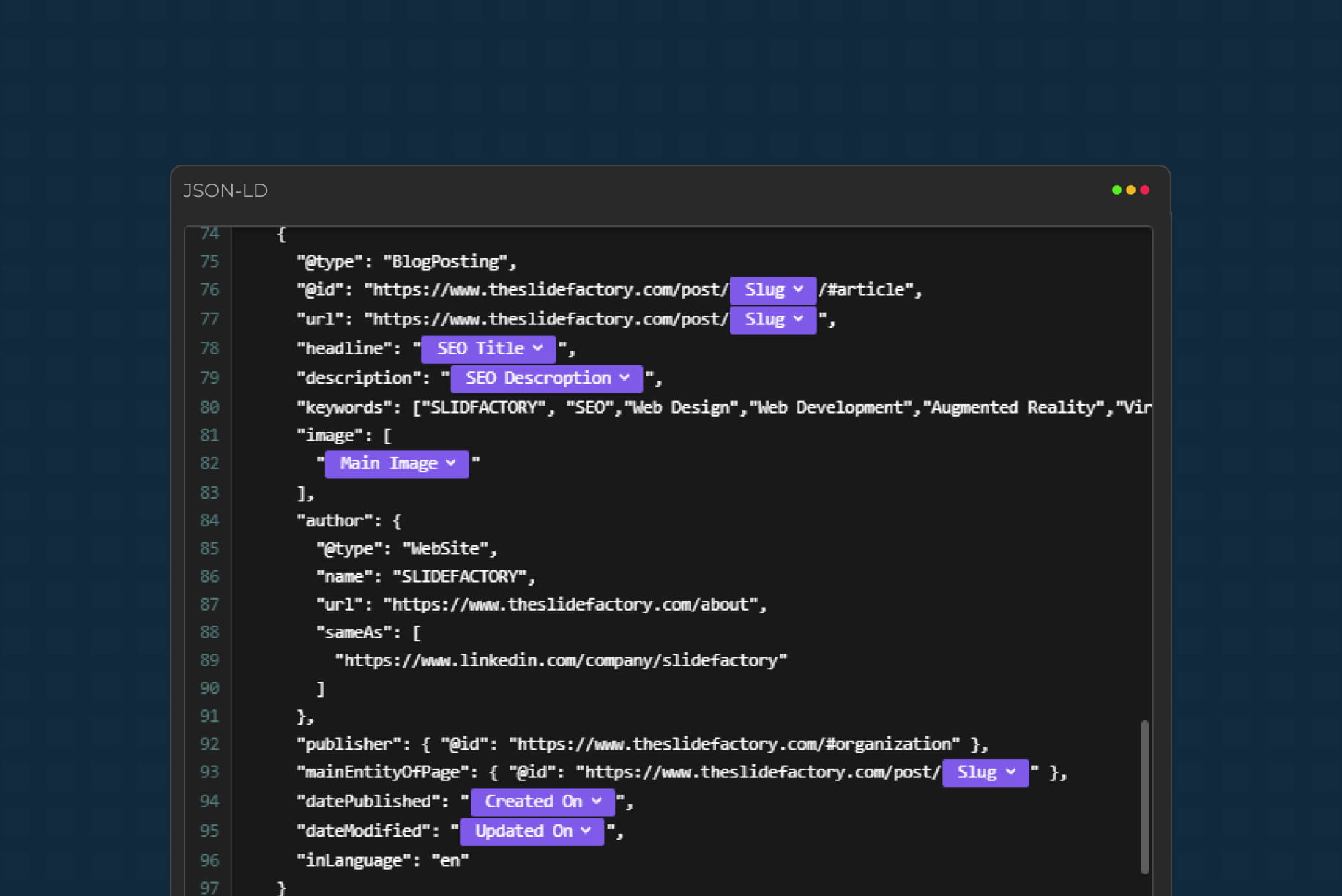
Basic metadata isn’t enough anymore. In 2026, strong SEO is built on interconnected schema using JSON-LD to create a unified understanding of your business.
By linking your Organization to real People (your experts) and then to specific Services, you create a clear chain of authority. Adding sameAs links to verified social profiles tells AI systems, “This is the same entity you’ve seen on LinkedIn, GitHub, and industry publications.”
This structure directly supports Google’s E-E-A-T standards and builds the trust AI engines need before recommending your brand.
4. Interactive & Immersive Signals
SLIDEFACTORY is based in Portland, Oregon, and focuses on AI-driven creative technology. We specialize in interactive development, AI creative, and immersive VR and AR experiences.
Modern AI search engines are multimodal. They don’t just read text. They understand video, audio, and even 3D environments.
How this plays out:
- Multimedia Context
When we build VR training tools, AR activations, or generative video, we make sure the metadata behind those experiences is just as strong as the visuals themselves. That way, when someone searches for things like “immersive training solutions in the Pacific Northwest,” your digital experiences are what the AI surfaces first.
5. Digital Mentions Over Traditional Backlinks
Links still matter, but AI models care even more about consensus. They look for your brand being discussed across trusted platforms like Reddit, Quora, and industry-specific communities.
The shift in strategy:
Don’t just chase backlinks. Build authority. When AI systems see SLIDEFACTORY consistently mentioned as a leader in “Portland AI development” across multiple platforms, it reinforces our position inside the global knowledge graph.
2026 AI-Ready Checklist
| Feature | Why SLIDEFACTORY Uses It |
|---|---|
| llms.txt | Gives AI crawlers a fast, accurate understanding of your core offerings |
| JSON-LD Graph | Reduces AI hallucinations by defining real, verifiable brand entities |
| Multimodal SEO | Optimizes video, VR, and AR assets for visual-first AI discovery |
| Semantic Cues | Mirrors how people naturally ask AI questions using “What is” and “How to” language |
The Bottom Line
AI search has changed what it means to be found. Visibility is no longer about ranking pages. It’s about whether an AI system can clearly understand, trust, and reuse your content as an answer.
SLIDEFACTORY is an AI-focused digital studio. Since 2022, we’ve been designing and building custom AI applications, generative AI workflows, and AI-driven products, alongside hands-on AI consulting for growing teams. That experience directly informs how we approach modern search, content structure, and digital architecture.
In 2026, the brands that win are the ones AI can explain without guessing. Our role is to make sure your business is one of them.
See where your site stands in search and AI answers