
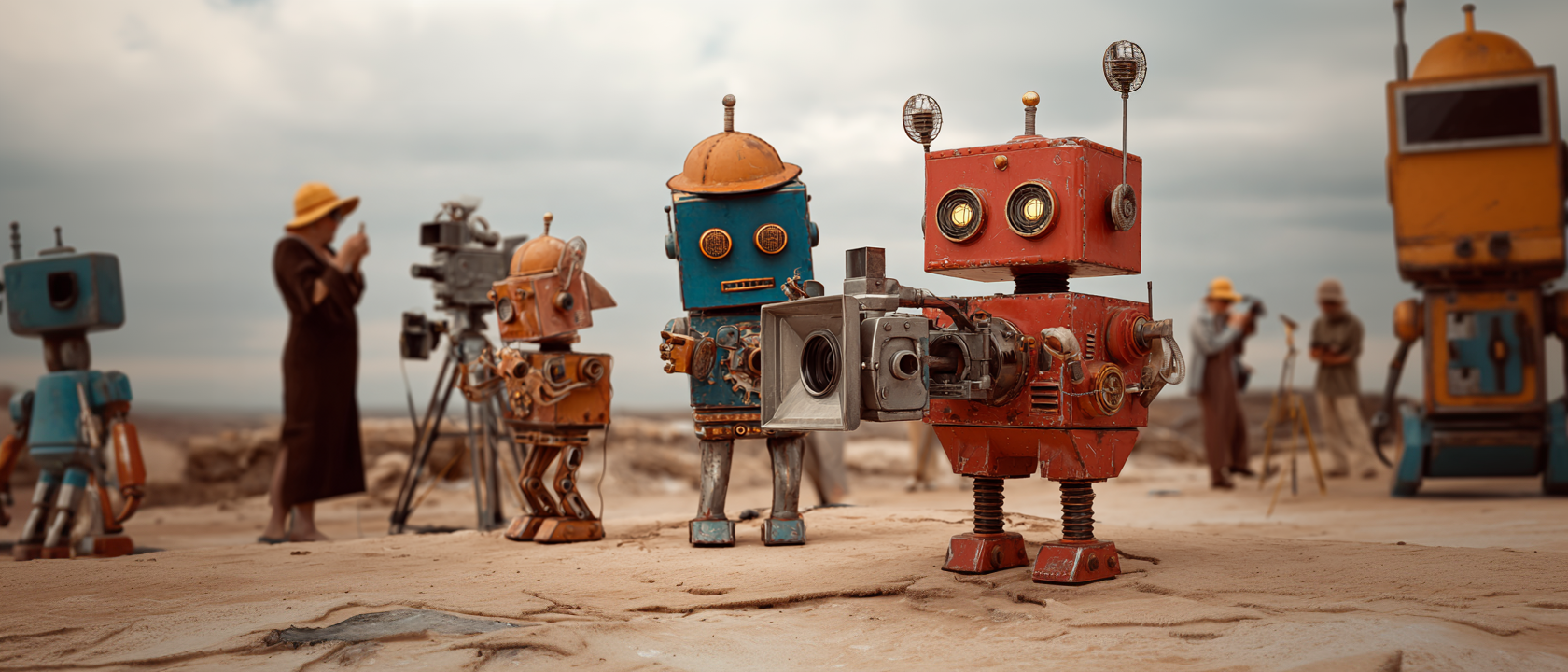
There is a moment in every media revolution when the gatekeepers lose the gate. It happened when desktop publishing made anyone a publisher. It happened when YouTube gave anyone a camera and a global audience. It is happening again right now, and this time the stakes are considerably higher than a blog post or a vlog.
For the past three years, the disruption conversation has lived almost entirely in the world of software. Developers watched uneasily as tools like Claude, Cursor, GitHub Copilot, and a wave of no-code and low-code builders began closing in on what used to require entire engineering teams. Agencies that built their value proposition on technical expertise started asking uncomfortable questions about their own futures. Founders discovered they could ship working products without hiring a single developer. The phrase “the death of the agency” became a fixture of every industry newsletter, podcast, and conference panel.
We have been living that conversation from the inside. Running an interactive digital agency, the questions we field from clients have changed dramatically in the last eighteen months. Not just what they want built, but whether they need us to build it at all. We have been experimenting with generative video creation for over three years, long before it was legible to most clients, and built products like CodeRaven partly because we saw where the tools were going and decided to move with the current rather than argue against it. That vantage point gives us a particular read on what is happening right now in a completely different industry. Because the same compression that hit software development is moving into entertainment, and the tools driving it are arriving faster than anyone in Hollywood planned for.
AI video generation has crossed a threshold in 2026 that most people outside the industry have not fully absorbed yet. Models like ByteDance’s Seedance 2.0 and Google DeepMind’s Veo 3.1 have pulled decisively ahead of the field, producing cinematic-quality video that would have been impossible two years ago. The gap between “this looks like AI” and “this looks like a film” is closing at a pace that mirrors what happened to coding, and the implications for who gets to make entertainment are enormous.
A Pattern the Tech Industry Already Lived Through
To understand what is coming for entertainment, it helps to look back at what happened to software and ask whether the trajectory is the same.
When Claude, Copilot, and tools like Lovable and Bolt arrived at scale, they did not kill software development overnight. They did something more structurally significant: they decoupled creative and strategic capability from technical execution. A founder with a clear product vision could now build without needing to hire a team to translate that vision into code. A marketing director could spin up an internal tool without submitting a ticket. The bottleneck moved. The people who were the bottleneck lost leverage.
We saw this directly with our own client base. Requests that used to begin with “can you build this for us” increasingly began with “we started building this ourselves, can you help us think through it.” The conversation shifted. Clients were not coming to us because they could not access the technical capability anymore. They were coming to us because strategic clarity and creative direction, the things that make a product actually good rather than merely functional, still required experienced thinking. That shift changed how we talk about what we do and what we charge for.
Agencies built around pure technical production felt it hardest. The ones whose value was “we know how to build this and you don’t” had the thinnest moat when the tools started knowing how to build it too. The entertainment industry is about to enter that same conversation, and it has even less runway than software agencies did.
What These Models Actually Do
To understand the shift, you have to understand what these tools are capable of beyond the marketing copy.
Seedance 2.0 is a truly controllable multimodal AI video model. It accepts up to nine images, three videos totaling fifteen seconds, and three audio files simultaneously, allowing creators to combine text, images, video, and audio freely. It maintains consistent faces, clothing, text, scenes, and visual styles across an entire video, solving what was previously one of the hardest problems in AI video: character drift between frames.
That last point matters enormously, and it is the one that caught our attention most. Character consistency was the wall that kept AI-generated video from being used for anything resembling narrative storytelling. If your protagonist looks like a different person in every shot, you cannot tell a story. That wall is now gone.
Seedance 2.0 delivers cinematic output aligned with industry standards, supporting images, audio, and videos as references, enabling creators to transform an idea into visuals with full control over performance, lighting, shadow, and camera movement. Meanwhile, Google’s Veo 3 takes a different approach, betting on photorealism and native audio co-generation, shipping dialogue, ambient sound, and music directly alongside video frames.
These are not toys. These are production tools. And crucially, the barrier to using them is a subscription and a good idea. The same sentence could have been written about Claude and software development eighteen months ago. We know, because we wrote a version of it then.
A Screenwriter Already Said the Quiet Part Out Loud
The entertainment industry noticed. Shortly after Seedance 2.0 was released, realistic clips based on real actors, TV shows, and films went viral across the internet. After viewing one particularly striking clip, Rhett Reese, co-writer of Deadpool and Wolverine and Zombieland, announced on social media: “I hate to say it. It’s likely over for us,” adding that in next to no time, one person is going to be able to sit at a computer and create a movie indistinguishable from what Hollywood now releases.
That statement deserves to be taken seriously not because it is certainly true, but because it is coming from someone who knows exactly what goes into making a film. We heard the same sentiment from developers watching Copilot write production-ready functions from a comment. The same vertigo. The same professional instinct that something fundamental had just shifted.
When a domain expert looks at an AI tool and says “this is going to end my profession,” that is not panic talking. That is pattern recognition from someone who understands what their job actually consists of and how much of it the tool just absorbed. We have had that conversation with enough developers, designers, and strategists over the past two years to know exactly what it sounds like. Hollywood is having it now.
From Killing Agencies to Killing Studios
The agency conversation was always really a conversation about production middlemen. The argument for hiring an agency was never just technical skill. It was access. Access to the tools, the workflows, the people who knew how to operate them, and the institutional knowledge that could not be easily transferred to a client. AI eroded all of that simultaneously.
We have thought carefully about this at SLIDEFACTORY, because it is our own industry. The answer we keep arriving at is that the agencies which survive are not the ones clinging to production complexity as a differentiator. They are the ones that moved up the value chain toward creative direction, strategic thinking, and the kind of experiential and interactive work that still requires human taste and judgment to get right. Our award-recognized work was never really about the technical execution. It was about the idea, the interaction design, the understanding of how people engage with an experience. Those things do not get automated the same way a component library does.
Hollywood studios occupy a structurally similar position. They have long controlled entertainment not because they have a monopoly on good ideas but because they control the production infrastructure that turns ideas into something an audience can watch. The cameras, the crews, the post-production pipelines, the distribution relationships. Like agencies, their leverage was never the idea. It was the gap between the idea and the execution.
That gap is closing. Seedance 2.0 promises campaign-ready videos from product photos with no production team needed, and action sequences with intense fight choreography, collision physics, slow motion, and bullet time. Runway positions the same technology for short films and cinematic storytelling. The production infrastructure that used to require a studio is now accessible for a monthly subscription fee. The gap between idea and execution is narrowing in entertainment exactly the way it narrowed in software, and the studios that built their business model around owning that gap are going to feel it the same way agencies did.
The Infrastructure Is Already Being Built
Here is what makes this moment different from previous waves of AI hype: the distribution infrastructure is not waiting for the technology to arrive. It already exists and is actively adapting.
YouTube CEO Neal Mohan described the platform’s 2026 direction by positioning creators as both stars and production studios, writing: “When creators hold the keys to their own production and distribution, the only limit is their imagination.” He is not speaking metaphorically. He is describing the business model YouTube is actively building toward.
Over one million channels were already using YouTube’s AI creation tools daily by the end of 2025, and 2026 plans include expanded capabilities such as generating Shorts using a creator’s own likeness and creating simple games via text prompts. YouTube is not resisting this shift. It is funding it.
The broader creator economy is estimated to be worth approximately $191 billion in 2026, potentially reaching $528 billion by 2030 according to industry analysts. The money is already there. The question is whether AI video accelerates creator participation in it or radically restructures who the creators are. We think it does both simultaneously, which is what makes it genuinely disruptive rather than merely additive.
The YouTube-Style AI Channel Is Not a Future Concept
The logical endpoint of this trajectory, an individual or small team running a channel powered almost entirely by AI-generated video content, is not speculative. It is already happening in embryonic form, and the tools to do it at scale are available today.
Consider what a motivated creator can now assemble. A language model generates the script. A text-to-speech model handles narration. Seedance or Veo generates the visuals. A music generation tool scores the episode. A video editing tool stitches it together. The result is publishable content that, at its best, is visually indistinguishable from mid-budget professional production.
This is the same stack that replaced the agency developer pipeline, just aimed at a different output. Claude writes the code. Seedance shoots the scene. The operator becomes the creative director, and the creative director no longer needs a production company behind them. We are already helping clients think through these workflows on the interactive and experiential side. The video side is catching up faster than most people realize.
The channels that will define this space will not look like static AI content farms. They will look like actual shows with consistent characters, recurring storylines, episodic structure, and audience relationships. The difference is that the production studio will be a single person with a laptop and a monthly API spend that would not cover one day of traditional crew costs.
YouTube’s own CEO put it plainly: “The most important creator on YouTube in five or ten years is someone you’ve never heard of and that person is starting their channel today.” He said that in the context of AI tools. He is not wrong about the timeline.
The Tension the Industry Cannot Escape
None of this happens cleanly. The legal, ethical, and quality questions are real and they are not resolved.
Seedance 2.0 was quickly denounced by the Motion Picture Association for copyright infringement. The Walt Disney Company sent ByteDance a cease and desist letter alleging the model was trained on Disney works without compensation. Paramount Skydance accused the company of engaging in blatant infringement of its intellectual property including Star Trek, South Park, and Dora the Explorer.
The training data question will be litigated for years. Software developers faced a version of this with Copilot and the code it was trained on. The entertainment industry’s version is louder and more photogenic, but structurally it is the same argument: who owns the patterns a model learned, and what does compensation look like when those patterns power someone else’s creative output. It will not be settled quickly, and it will not stop the technology in the meantime. We have watched the same dynamic play out in our own space long enough to have a strong opinion on that.
The quality problem is the other side of this. YouTube is actively working to combat low-quality AI-generated content that adds little value to the platform experience, what is colloquially being called “AI slop,” extending systems already used to counter spam and clickbait. The flood of low-effort, prompt-and-publish content is real and it is already degrading discovery for quality creators. The platforms know this. The algorithmic countermeasures are coming.
Which means the winners in AI-driven entertainment will not be whoever can generate the most content. They will be whoever can generate content that an audience actually wants to watch. The same lesson the software world is learning, and the same one we reinforce with every client we work with. Vibe coding a broken app in twenty minutes still produces a broken app. Prompting your way to a mediocre short film still produces a mediocre short film. The tools lower the production barrier. They do not lower the storytelling barrier.
What the Curve Looks Like From Here
For most of 2024 and early 2025, the AI video generation conversation was fragmented across a dozen competing models with no clear winner. By 2026, that has changed significantly, with two models having pulled ahead in both capability and adoption. That consolidation is typical of maturing technology markets, and it signals that the experimental phase is ending and the production phase is beginning. The same arc played out in AI coding tools. The chaos of competing assistants resolved into a few dominant platforms that creators built real workflows around. We expect the video space to follow the same compression curve, probably faster.
The next two years in entertainment AI will likely bring longer generation windows, stronger temporal coherence across multi-scene narratives, better voice-to-lip synchronization, and real-time iteration so creators can refine shots the way a director calls for another take. When generation quality extends to five-minute coherent scenes rather than eight-second clips stitched together, the format possibilities open dramatically. Short-form AI channels exist today. Long-form AI series are not far behind.
The Deeper Pattern
If there is a single thread running through the software agency disruption and the coming entertainment disruption, it is this: AI does not kill creativity. It kills the infrastructure tax on creativity.
For decades, making software required you to pay a tax in the form of developers, tooling, and technical complexity before your idea could exist in the world. AI reduced that tax dramatically. At SLIDEFACTORY, we responded by doubling down on what the tools cannot replace: the strategic layer, the experiential thinking, the understanding of how people actually behave inside an interactive moment. The production commodity got cheaper. The thinking did not.
Entertainment is about to work the same way. Making a film used to require you to pay a tax in the form of cameras, crews, post-production pipelines, and studio relationships before your story could reach an audience. That tax is being reduced. The people who will thrive are the ones who understand story, character, and audience, and who can direct AI tools with enough creative precision to produce something worth watching.
The studio system that controlled entertainment for a century was built on scarcity of production capability. The agency model that dominated software services was built on the same thing. Both are confronting the same truth at the same time: scarcity of production capability is no longer a defensible moat.
What replaces it is taste, voice, and the ability to make an audience feel something. Those have always been the real currencies of creative success. AI just removed the tax that production complexity used to charge on the way in.
We have been saying a version of that to our clients for two years. Hollywood is about to learn it the hard way.
The conversation started with code. It was always going to end up here.