
Ox Alpha showed up on OpenRouter on August 20, 2026 under the ID stealth/ox-alpha. It has a 1,048,576-token context window, costs nothing to run, and has no company name attached to it. The listing calls it a reasoning model for coding, agentic work, and production workloads, and says a third-party provider built it, operates it, and chose to stay anonymous for the duration of the preview. Three days in, Ox Alpha was the second most-used model on OpenCode by recent volume. Still nobody has claimed it.
SLIDEFACTORY builds AI systems for clients and we operate CodeRaven, an AI code review platform, so we have a commercial stake in which models teams route production work through. That’s worth knowing before you read the rest of this. The Ox Alpha model is fast, free, and sized for exactly the kind of long-running agent work we do, which makes it the most interesting release of the month and, as of today, not something we’d point a client repository at. The reason for that sits in the listing, not in the benchmark scores.
Ox Alpha by the numbers
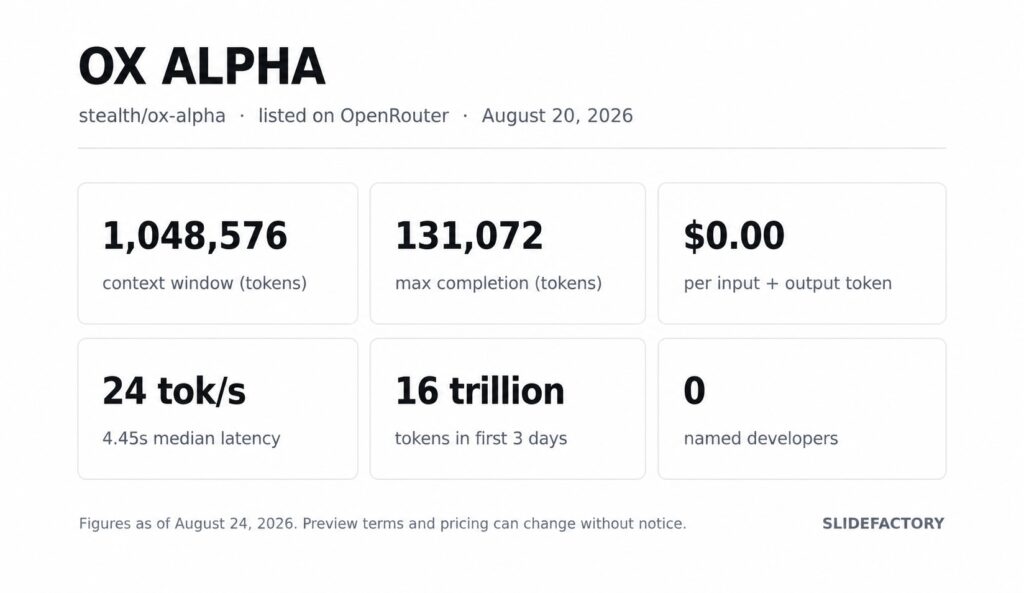
- 1,048,576 tokens of context, with completions capped at 131,072 tokens
- $0.00 per input token and $0.00 per output token on the current OpenRouter route
- Listed August 20, 2026. OpenRouter emailed users that its free route ran through August 24. OpenCode’s launch note promised a week, which points to around August 27
- Roughly 16 trillion tokens, 221,000 unique users, and 5 million sessions through OpenCode in the first three days, per OpenCode’s own live data page
- 24 tokens per second at 4.45 seconds median latency on OpenRouter’s page, against OpenCode’s claim of 50 to 60 tokens per second
- Text, image, and video input accepted. Audio requests come back rejected
- No named developer, no press release, and no published pricing for whatever follows the preview
Everything above comes from the public listings and from usage dashboards, which is the only kind of documentation Ox Alpha has. There’s no model card, no technical report, and no lab to email.
Ox Alpha’s 1,048,576-token window is the part that actually matters
The million-token figure is why this release got attention from people who build agents rather than people who follow AI news. Agent harnesses spend most of their context on things that aren’t the prompt: repo maps, file trees, test output, screenshots, the last forty tool calls. A window this size means a mid-size codebase and its failure logs fit in a single request, instead of getting retrieved in pieces while the model loses the thread between steps.
It’s also the easiest number in the release to overread. Capacity describes what a model can hold, not what it weighs correctly, and the usable share depends on the active route’s limits and on whatever you reserve for the response. Two details from Ox Alpha’s public API record matter more than the headline. Reasoning is mandatory and defaults to maximum effort, which explains the latency. And there’s no structured-output enforcement, which is a real problem for any agent that expects schema-valid JSON to come back.
One of Ox Alpha’s two routes keeps everything you send it
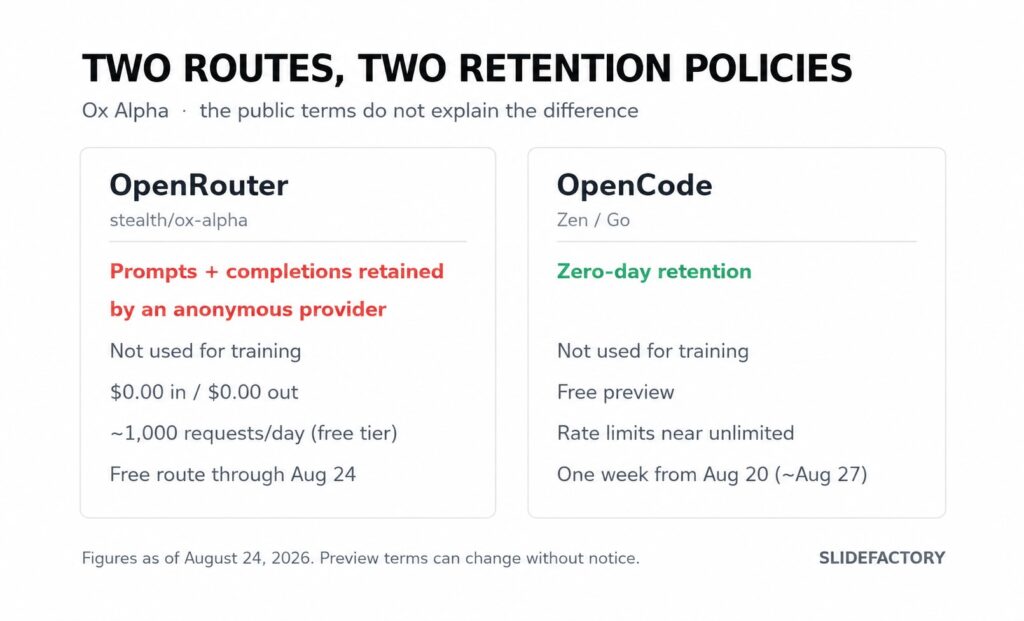
This is the line that settles it. OpenRouter’s notice says the anonymous provider retains prompts and completions, though it doesn’t use them for training. OpenCode‘s Zen and Go records assign the model zero-day retention and also say the data isn’t used for training. The public terms never explain the gap, so the OpenCode privacy posture doesn’t carry over to the OpenRouter route.
What that means in practice is that on at least one route, an unnamed party in an undisclosed jurisdiction keeps a copy of your input. On a weekend project, fine. Under a client NDA, that’s the entire decision, and no benchmark score touches it. Source code, internal docs, credentials sitting in a config file, customer records in test fixtures, incident write-ups: an agent harness moves all of it as ordinary context without asking. The one detail nobody is speculating about is the retention line, which happens to be the only part of the listing with legal consequences.
If you do run Ox Alpha, the route you pick is the control you have. The two published policies differ, they differ in writing, and neither gateway has explained why.
The 80% DeepSWE score came from 10 tasks and one developer
Most of the coverage traces back to a developer posting as @davis7, who ran Ox Alpha through 10 tasks on the DeepSWE software engineering benchmark and scored it above 80%, with Claude Fable 5 at 65% on the same set. A separate community run put it at 87.5% on Kingbench, second to GLM-5.3 and ahead of Opus 4.8.
Ten tasks is a sample size that wouldn’t survive a code review. Worth knowing, not worth planning around. There’s no eval card because there’s no lab admitting to the model, so every performance figure in circulation is community-generated. That’s a reasonable signal that something capable is behind the endpoint and a poor basis for a build decision. Testers have also noted Ox Alpha completes security-related work that other general-purpose models decline, which is a behavioral difference to account for rather than a feature to enjoy.
16 trillion tokens in three days is mostly a price signal
The usage numbers are real and they’re measuring curiosity at a cost of zero. Any free frontier-class endpoint with near-unlimited rate limits collects enormous traffic whether or not it holds up under sustained load, and nothing in the public data separates completed long-horizon runs from the ones people abandoned halfway. Patrick Collison, whose company is acquiring OpenRouter, called the model impressive on X. Credible, and still a first impression.
The tokenizer evidence points at GLM with roughly 90% confidence
Community fingerprinting of tokenizer vocabulary, video token accounting, error strings, and writing style lands on Zhipu’s GLM family, including a reported 95-of-95 tokenizer probe match. Other people have argued for an unreleased Microsoft MAI model, and a few have floated Google. TechCrunch covered the guessing without resolving it, which is about where things stand.
Attribution matters here for a practical reason rather than a geopolitical one. Whoever operates the endpoint determines which data protection regime applies to the prompts they’re retaining, and right now that’s unknowable from outside. OpenRouter has unmasked stealth models before, and Hunter and Healer both turned out to be Xiaomi MiMo releases. The usual pattern is that the model disappears and comes back later under its real name with real pricing.
How to call Ox Alpha while the preview lasts
Access runs through OpenRouter’s API using the model ID stealth/ox-alpha, in the OpenAI-compatible Chat Completions format, so existing clients work without much surgery. You need an account and an API key, and the key belongs in a server-side environment variable rather than anywhere a browser can reach it. OpenCode’s free tier and Nous Portal are the other two published routes.
A few things to budget for before you wire Ox Alpha into anything. Free-model rate limits on OpenRouter sat near 1,000 requests per day during testing, while OpenCode’s limits were described as close to unlimited. Reasoning defaults to maximum effort, so plan for latency instead of assuming the throughput numbers apply to your workload. Validate JSON yourself, because nothing upstream enforces your schema. And audio input returns an error, so multimodal here means text, images, and video only.
Ox Alpha’s free window closes between August 24 and August 27
That range comes from two sources that don’t agree. OpenRouter told users its free route ran through August 24. OpenCode’s August 20 note promised a week, which puts it near the 27th. Neither gateway published an exact cutoff or said what access looks like afterward. Anything built against stealth/ox-alpha shouldn’t assume the endpoint exists next month, and anything built around its cost profile shouldn’t assume the cost stays at zero.
What Ox Alpha’s numbers can’t tell you
- Whether the quality holds. Every score in this post came from individuals running small task sets inside the first 72 hours. None of it is reproducible eval work.
- Who is retaining your prompts. The provider is anonymous by design during the preview, so there’s no entity to send a data processing agreement to.
- What it will cost. No post-preview pricing exists on either route.
- Whether it survives. Stealth previews are time-boxed experiments. Some return with a name on them, some don’t return.
- How it behaves in week three. Long-horizon agent work fails in ways that only surface over sustained runs, and nobody has had Ox Alpha long enough to know.
What we’d do with these numbers
- Test it on nothing that matters. Open-source repos, throwaway scaffolding, and public sample data are the right surface for a model whose operator you can’t name.
- Keep the retention line in the decision. If your contracts specify where client code may be processed, an anonymous provider fails that test no matter how it scores.
- Don’t port an agent harness to Ox Alpha this week. Building tooling against an endpoint with an announced end date and no published pricing is work you’ll do twice.
- Watch for the reveal instead of the benchmarks. A name, and the terms that arrive with it, will change the math more than another round of community scores.
- Take the context window seriously as a design input. Whoever ships a million-token coding model with real terms attached is going to change how agent workflows get built, so the harness work is worth prototyping now on a model you can actually sign a contract with.
None of this pattern is new. We published our own numbers from five months of AI code review on real client work, and the useful findings were never the ones in anybody’s launch announcement. Same discipline applies to a model with no launch announcement at all. If you’re sorting out which models belong in a production pipeline and which ones belong in a sandbox, that’s the work our AI development practice does, and it’s the problem CodeRaven was built around: review that stays consistent while the models underneath it keep getting swapped out. Happy to talk through where a stealth model like Ox Alpha fits and where it doesn’t.
Sources: OpenRouter’s Ox Alpha listing, TechCrunch, SiliconANGLE. Figures accurate as of August 24, 2026.